AI Overview
A golf warm-up should prepare the movements and speeds you will need on the course, not tire you out before the first tee. That means raising body temperature, working through the hips, upper back and shoulders, then building from easy practice swings towards your normal swing speed. For most golfers 8 to 10 minutes is a practical target. Dynamic warm-ups are better supported than static stretching for golf performance, and the evidence that any warm-up reduces golf injury risk remains mixed.
Key Highlights
- Eight exercises, 8 to 10 minutes, done beside the practice area with a club.
- Dynamic movement beats static stretching before a round. Save the static work for afterwards.
- Finish on progressive practice swings, building range and then speed.
- Static stretches of 60 seconds or more per muscle group show the largest performance reductions.
- Mobility is range you can control. Flexibility is range you have. Golf needs the first.
- If the same restriction shows up every round, measure it rather than adding more stretches.
I use a golf warm-up to prepare the movements and speeds you will need on the course. That means getting your body moving, working through the hips, upper back and shoulders, then building from easy practice swings towards your normal swing speed.
You do not need 20 minutes of stretching beside the first tee. For most golfers, I use 8 to 10 minutes as a practical starting point.
Golf research supports dynamic warm-ups. A systematic review found that dynamic warm-ups and routines that included resistance exercise tended to improve measures of golf performance, while the evidence around warm-ups and golf injury remained mixed. [1](https://pubmed.ncbi.nlm.nih.gov/31469762/)
Quick Summary
A useful pre-round routine should:
- Raise your body temperature and get you moving.
- Take your hips, trunk and shoulders through useful ranges.
- Finish with golf swings that build in range and speed.
- Leave you ready to play, rather than tired before the first tee.
Here is the routine I recommend as a starting point.
My 10-Minute Golf Warm-Up Routine
| Golf Warm-Up Exercise | Time or Reps | Main Area |
|---|---|---|
| Brisk walk with arm swings | 60 seconds | Whole body |
| Hip hinges with club | 8 reps | Hips and trunk |
| Squat to reach with club | 6 to 8 reps | Lower body and trunk |
| Reverse lunge with club rotation | 5 each side | Hips and rotation |
| Standing upper-back rotations | 6 each side | Upper back |
| Standing hip rotations | 6 each side | Hips |
| Walk club shoulder rotations | 6 to 8 reps | Shoulders |
| Progressive practice swings | 8 to 12 swings | Golf-specific preparation |
1. Start With a Brisk Walk and Arm Swings
60
seconds
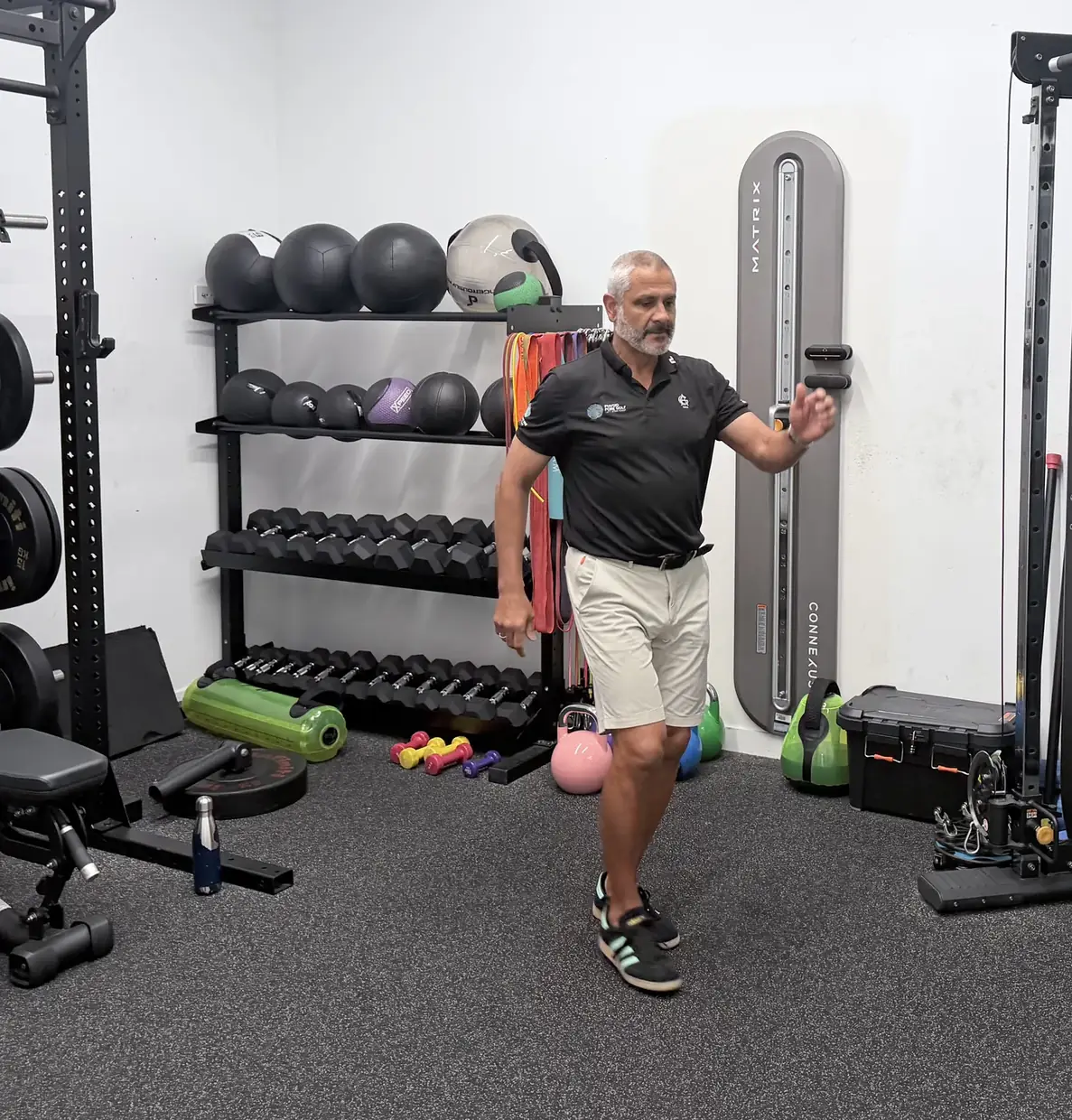
Walk around the practice area at a good pace and let your arms swing. Increase the size of the arm movements as you go.
If you have walked from the car park with your bag, you may have covered much of this already.
I want some whole-body movement before targeting individual joints.
2. Hip Hinges With Club
8
reps
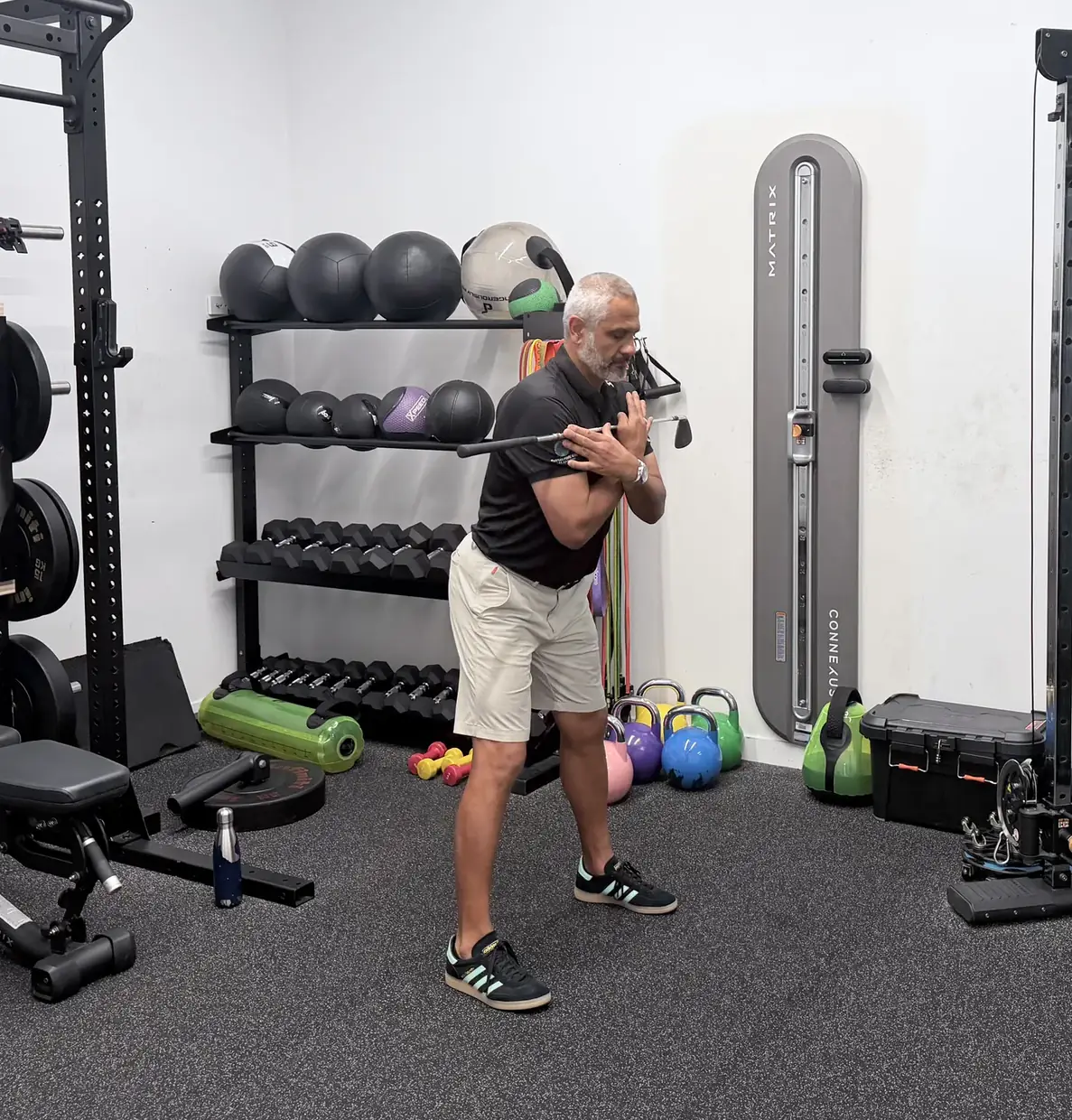
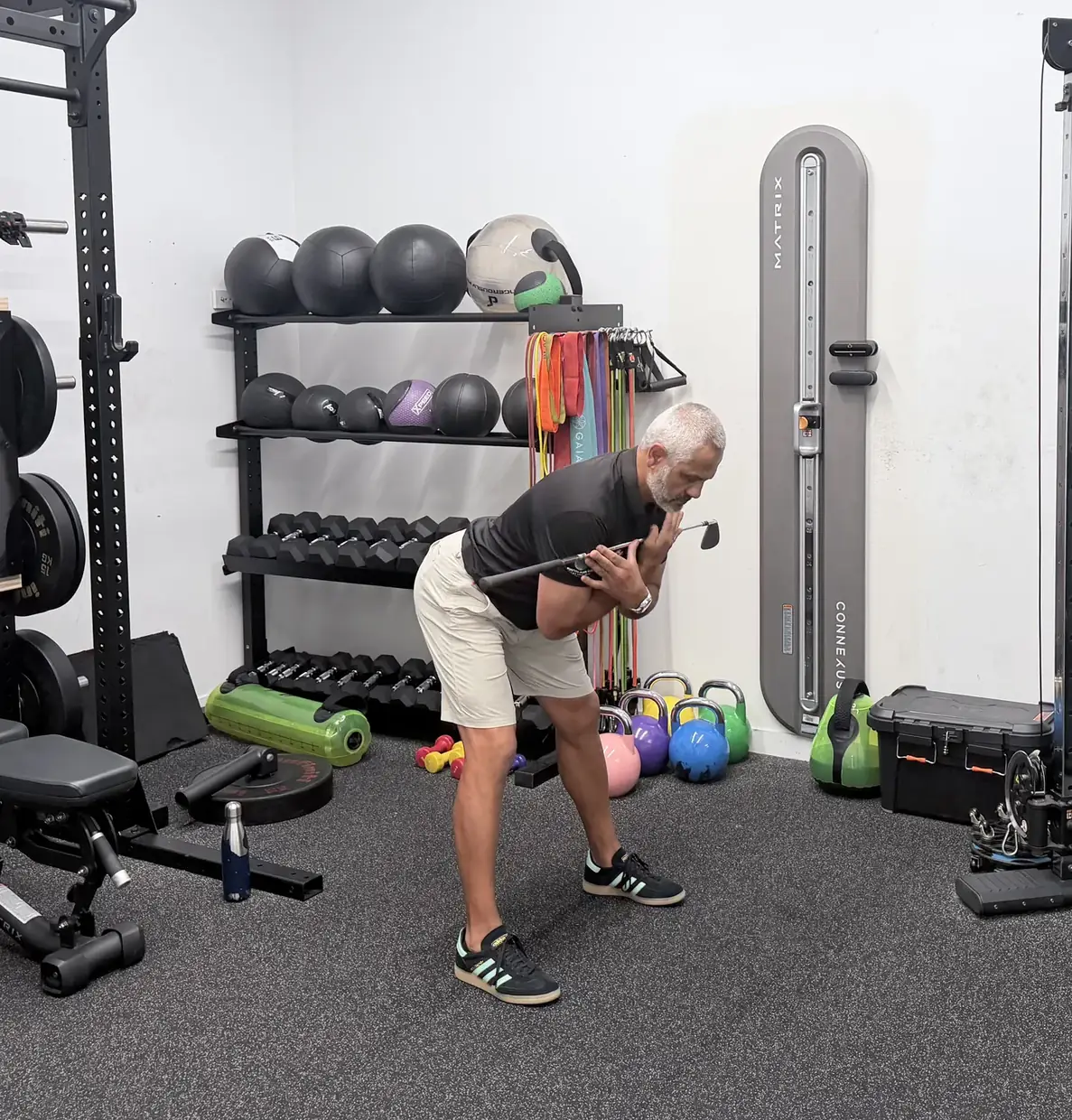
Stand with your feet around hip-width apart, holding a club in front of your chest.
Push your hips back while keeping a small bend in your knees. Let your torso move forwards from the hips, feel the dynamic stretch in the back of your legs, then stand tall again.
Keep the range comfortable and back neutral. You do not need to reach towards the floor.
The golf set-up asks you to hold a forward-bent position while your pelvis and trunk rotate, so I like to introduce hip movement before adding rotation.
3. Squat to Reach With Club
6-8
reps
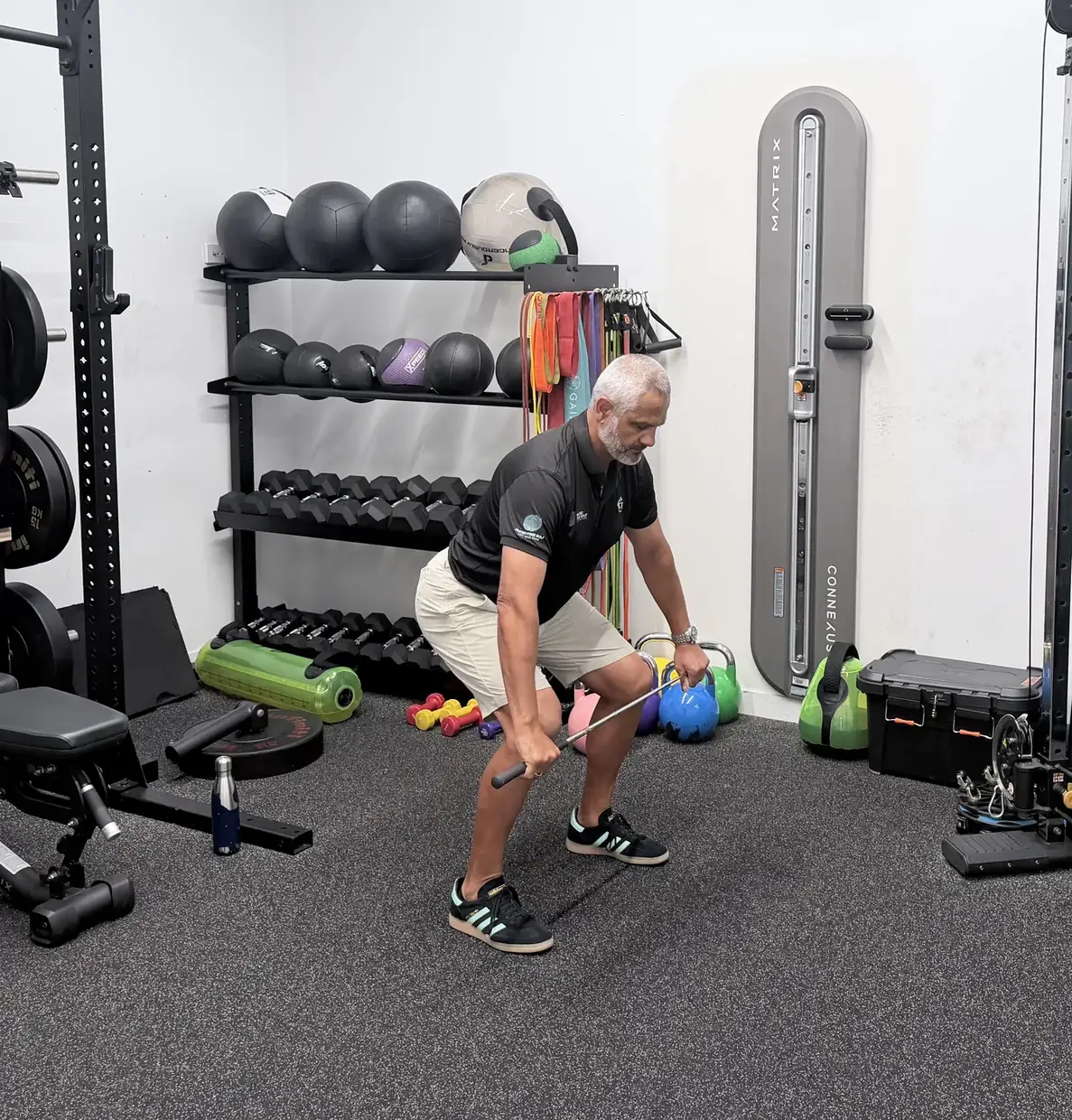
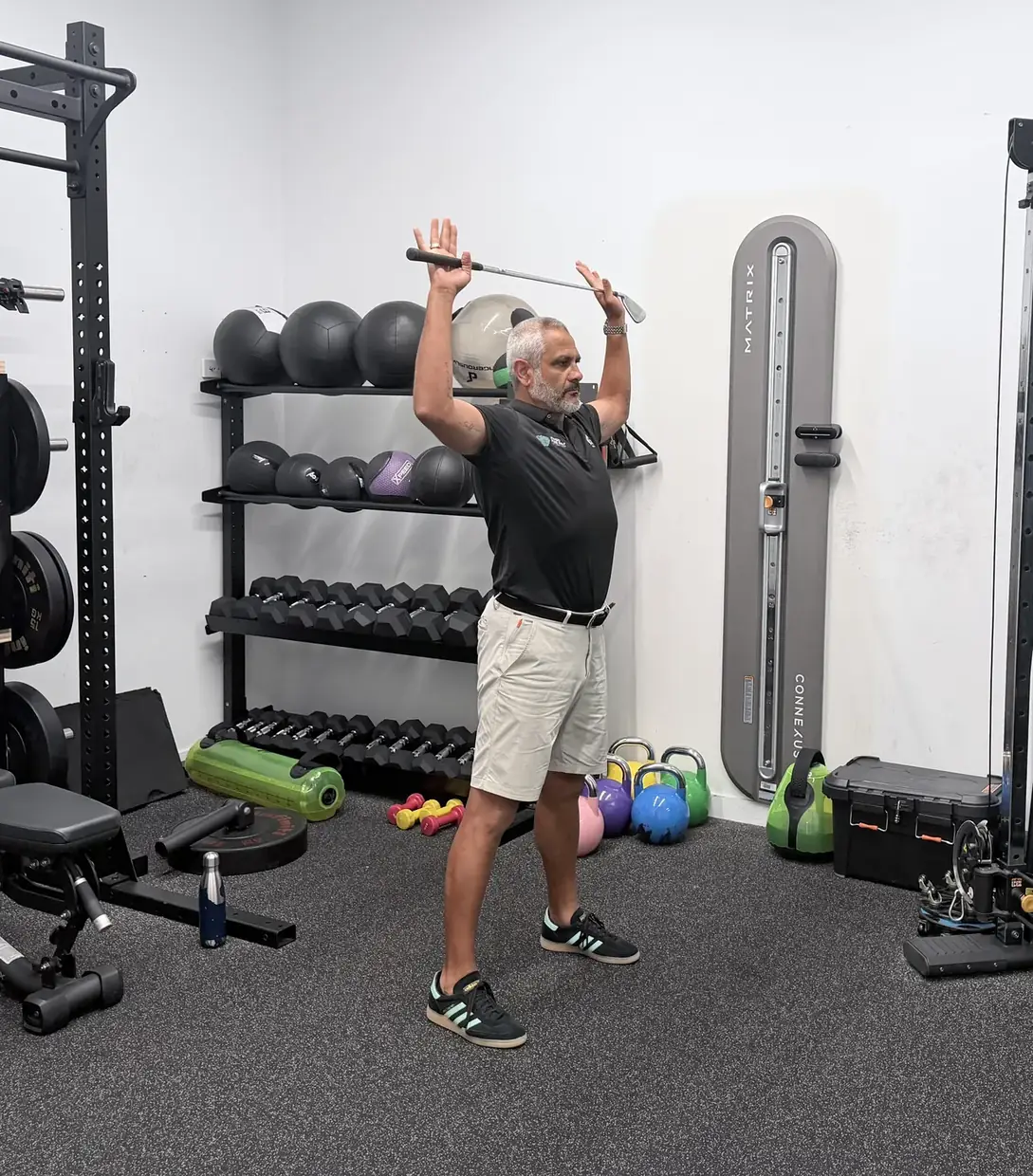
Stand with your feet a little wider than hip-width, also holding a golf club in front.
Drop into a comfortable squat relaxing the arms. Then stand up and reach your arms overhead, rotating the club behind your head to open your chest. Repeat at a steady pace.
The exercise moves the ankles, knees, hips and chest together.
Golfers sometimes focus so much on rotation that they forget what the lower body contributes to the swing. Research has linked lower-body strength and power with clubhead speed and carry distance, although a warm-up prepares those qualities rather than developing them. 6
4. Reverse Lunge With Rotation
5
each side
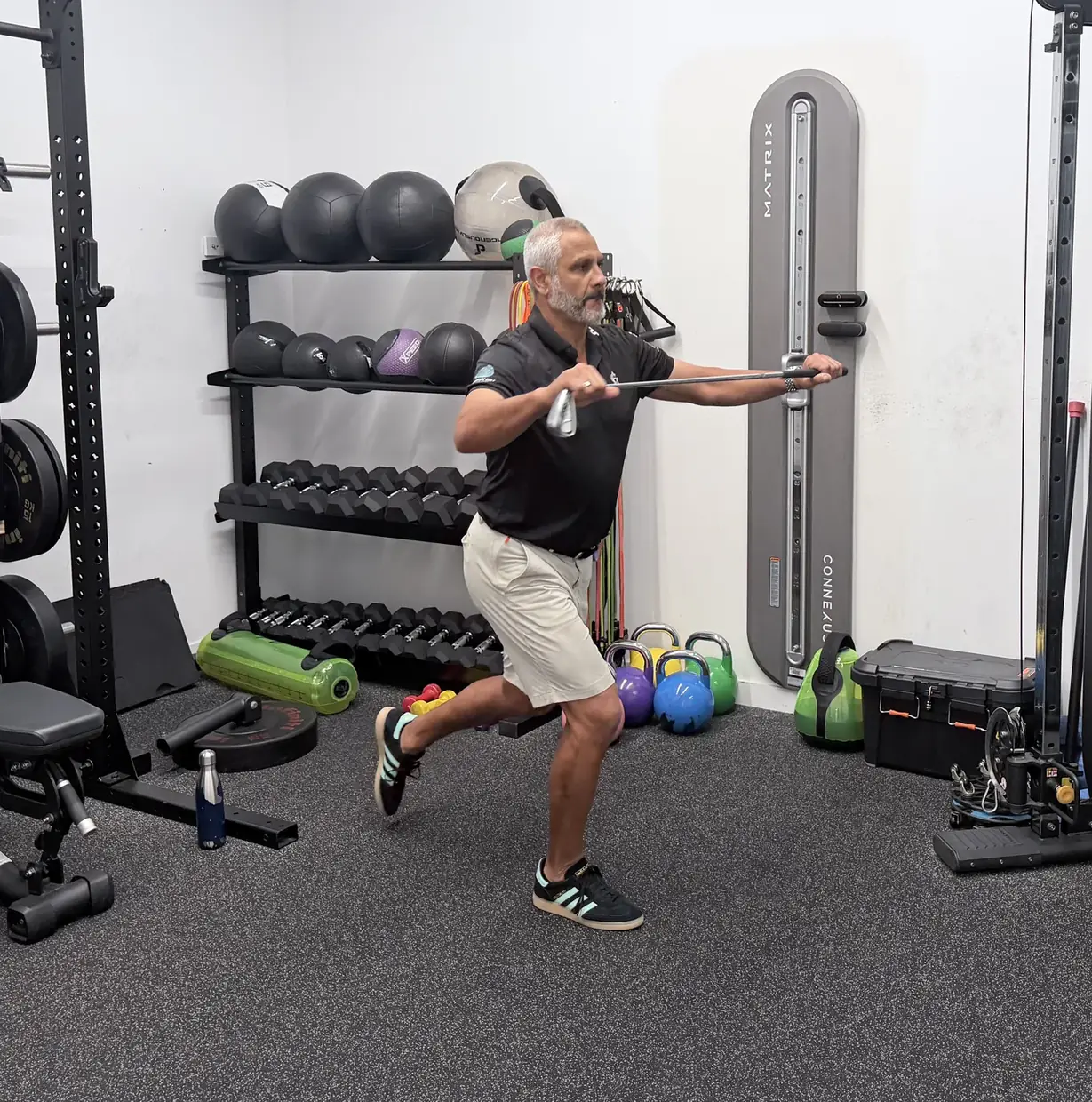
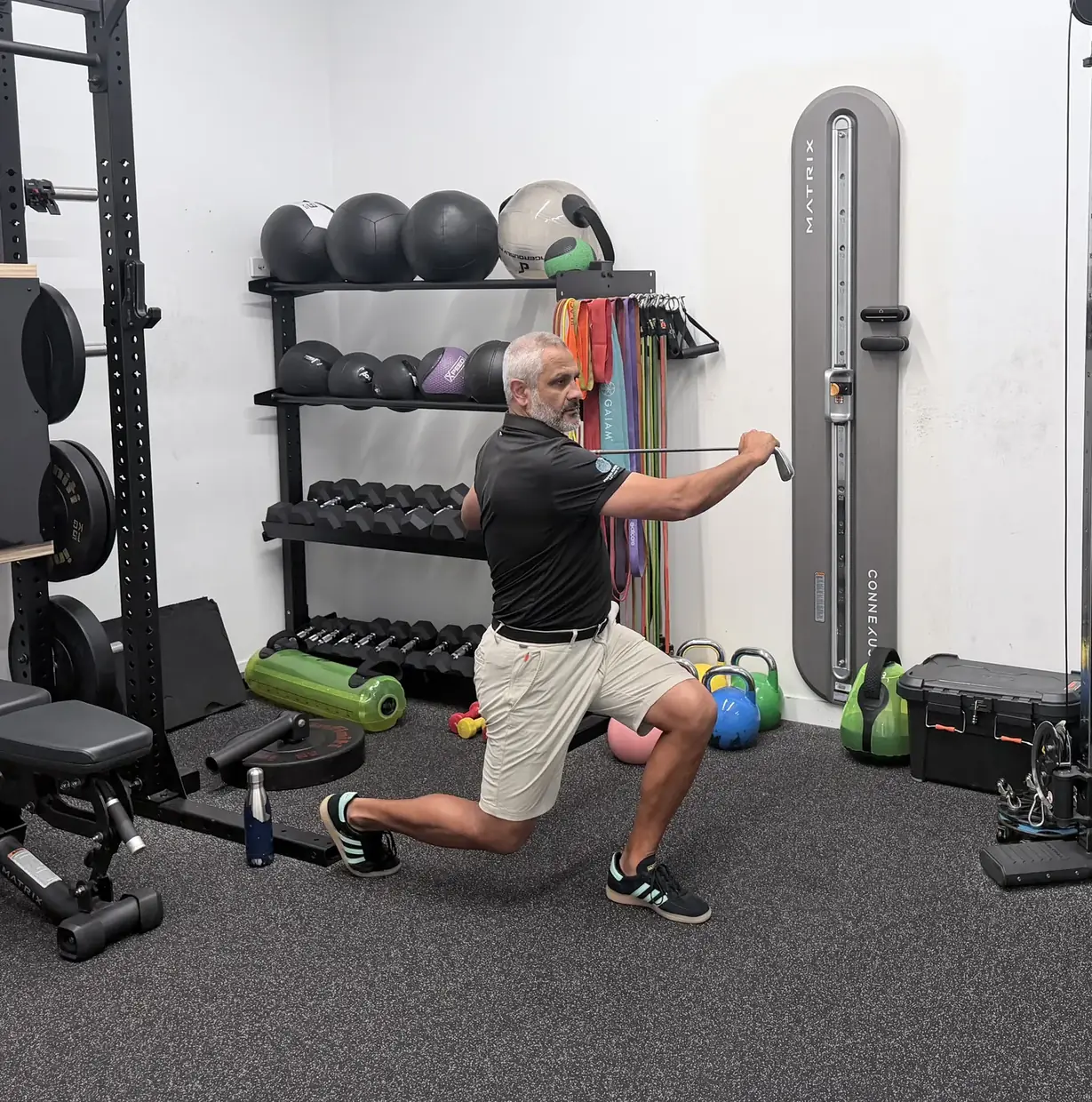
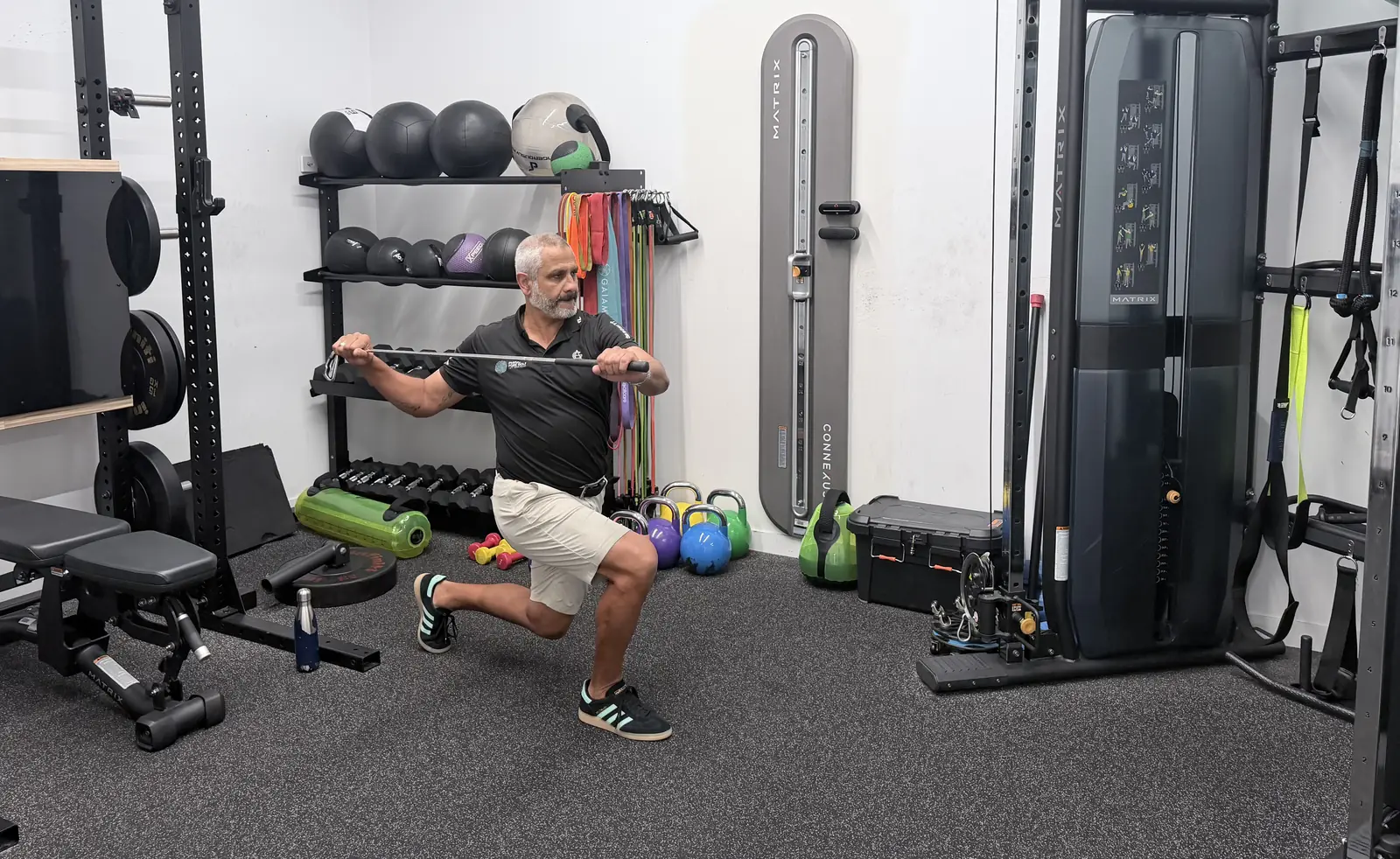
Standing holding a club out in front of you. Step one foot backwards into a short reverse lunge.
Then rotate the club turning your chest towards the front leg, then return to the upright starting position. Alternatively repeat sides.
The exercise can be made easier, if you hold the golf club across your chest it may help you control the movement more effectively.
Use a range you can control. Forcing another few degrees of rotation adds little to a pre-round warm-up.
5. Standing Upper-Back Rotations
6
each side
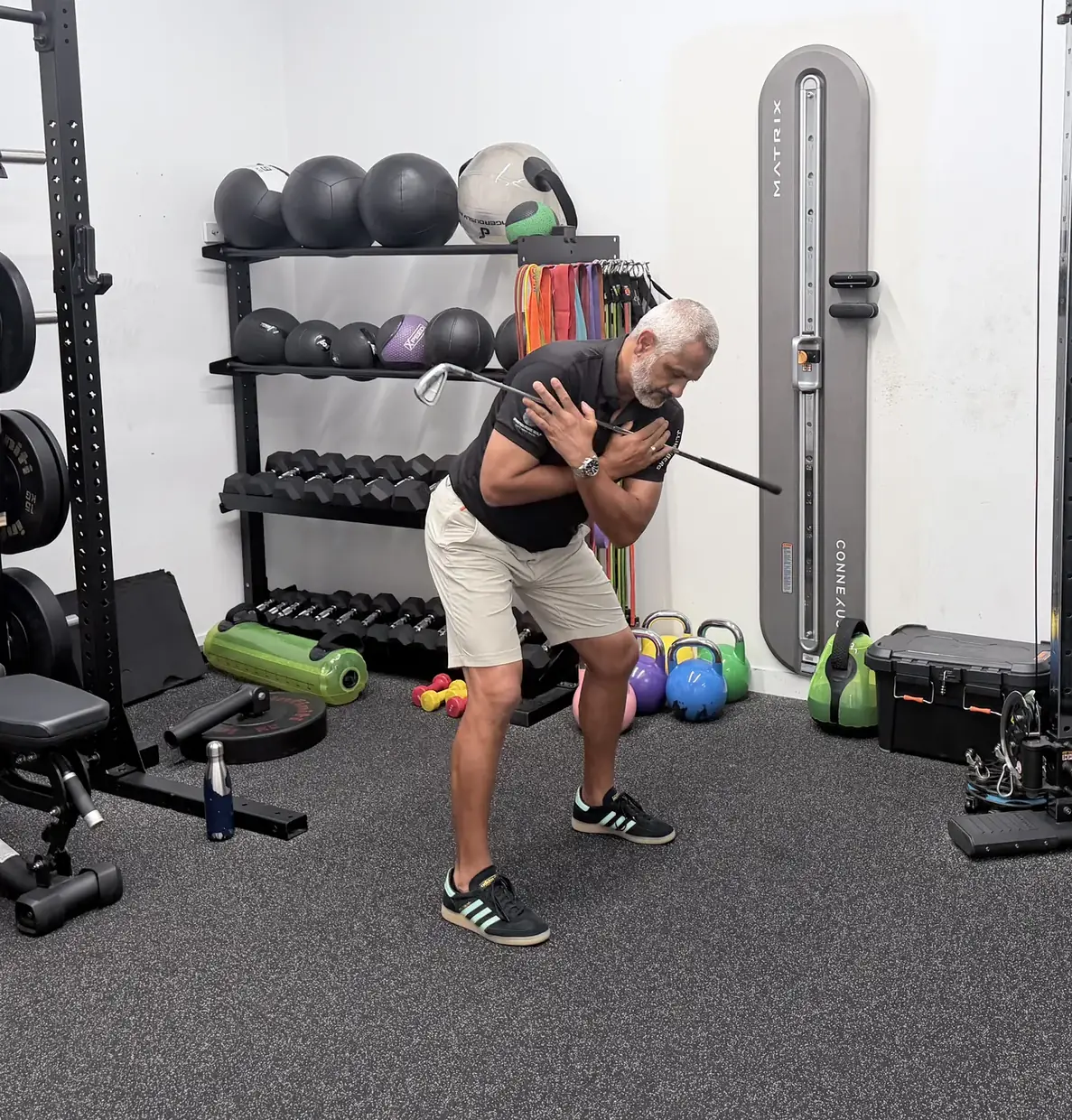
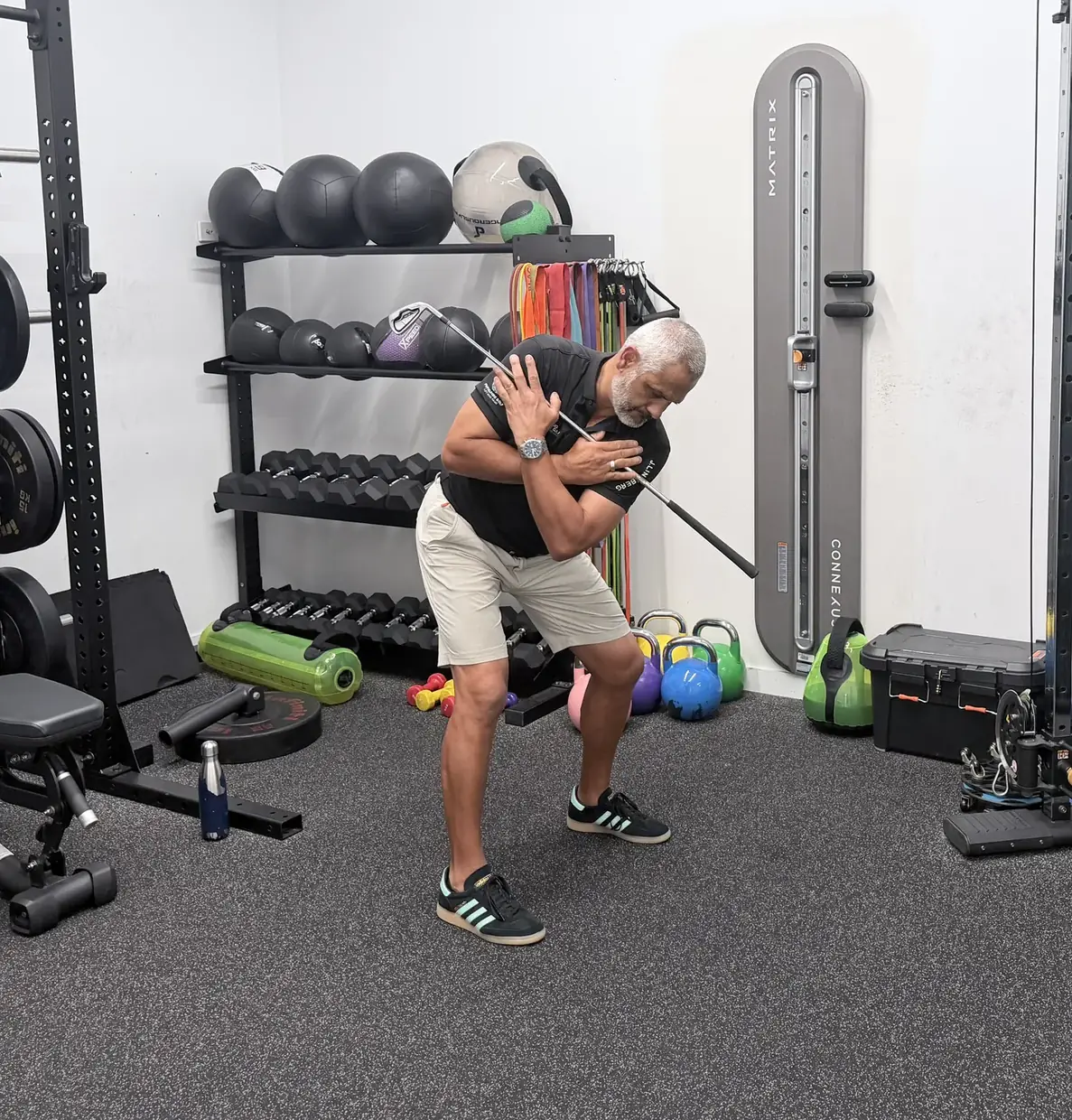
Hold a club across your chest and move into a comfortable golf posture.
Turn your chest to one side, return to the centre and repeat on the other side.
Your upper back, or thoracic spine, contributes to trunk rotation during the golf swing. Golf biomechanics research shows that the swing depends on movement across several body segments rather than one joint working on its own. 7
I want smooth movement here. Save the faster rotation for the practice swings later in the routine.
6. Standing Hip Rotations
6
each side
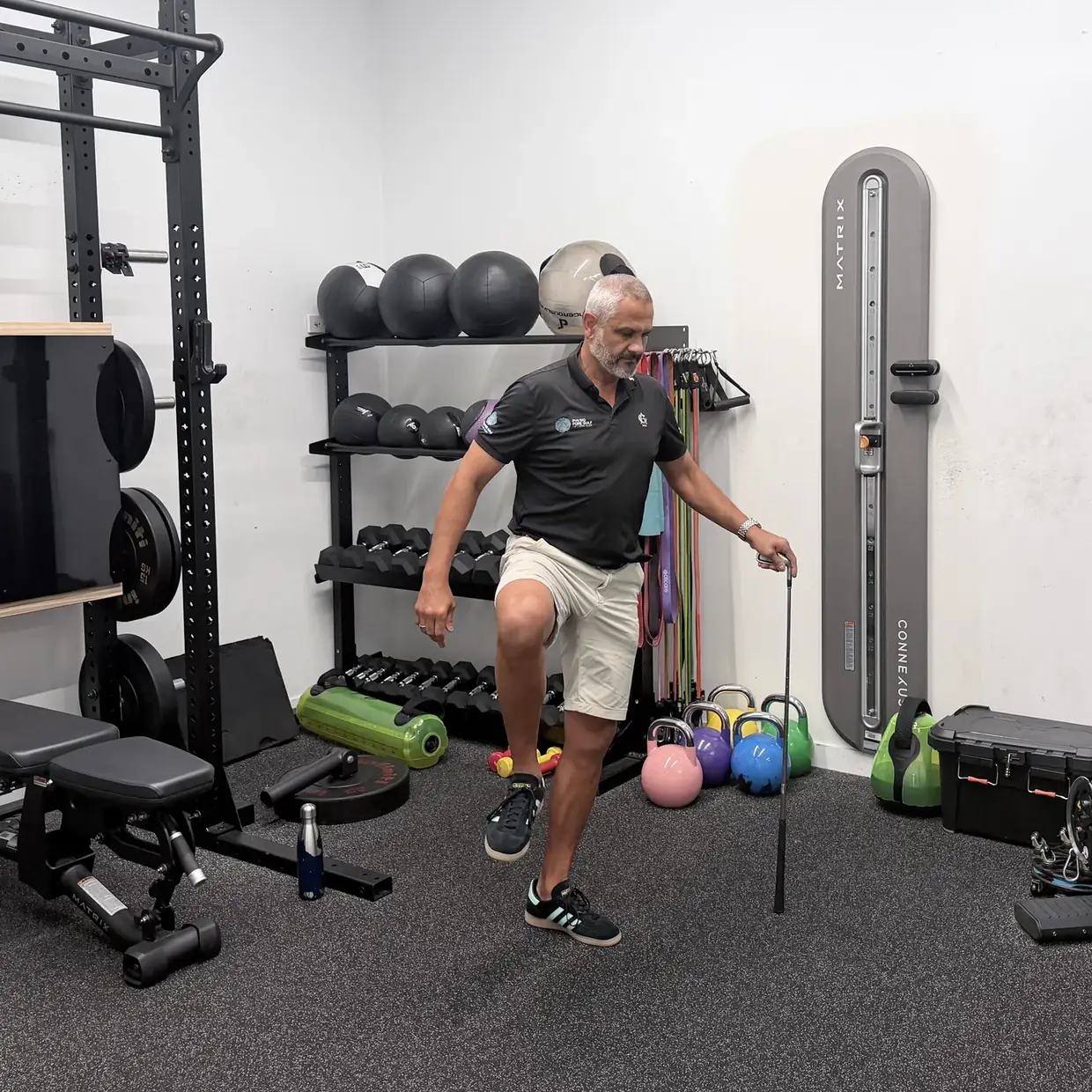
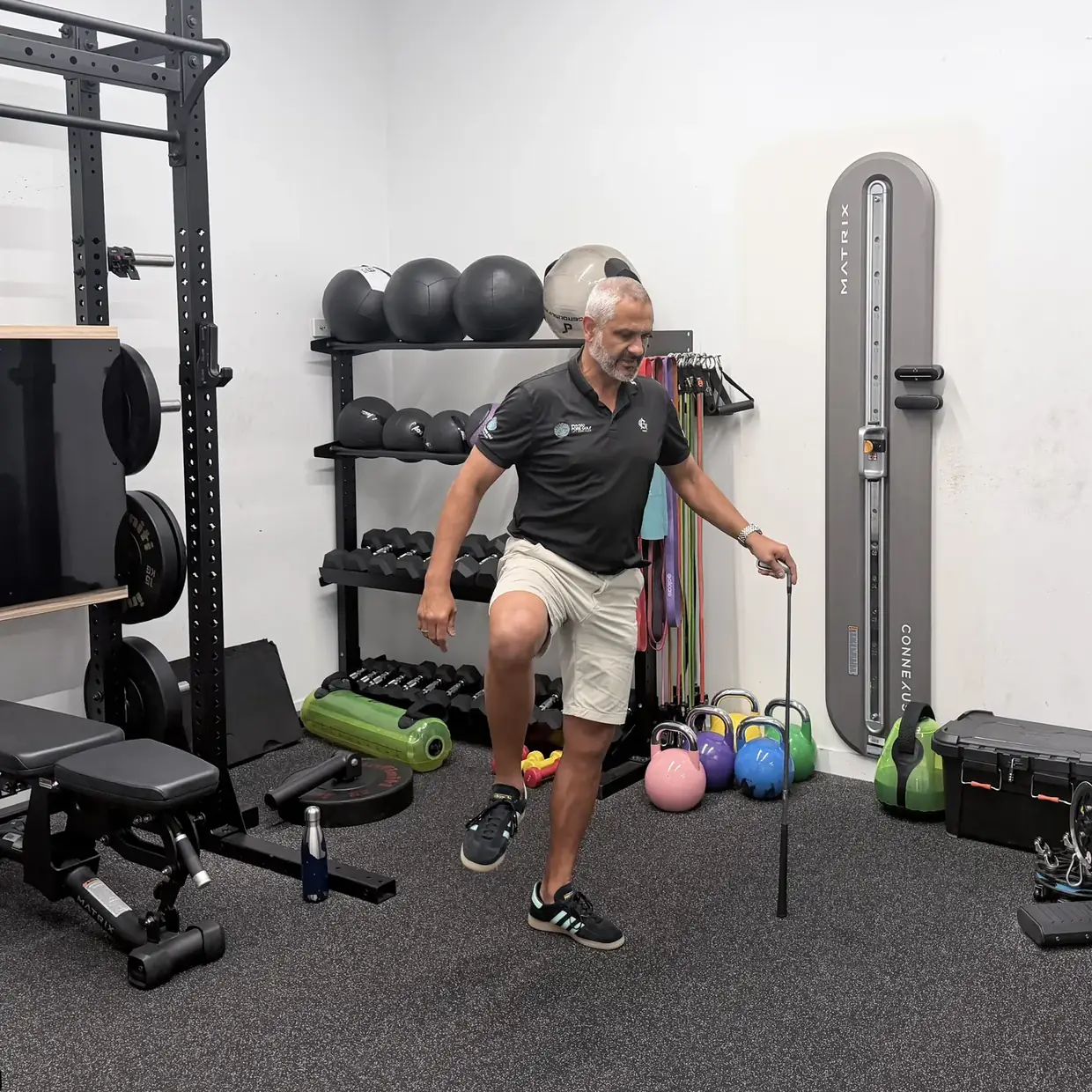
Use a club for balance if you need it.
Lift one knee and take the thigh through a comfortable circle. Repeat in both directions before changing legs.
Try to keep your pelvis under control. If your whole body turns with the leg, you are no longer getting much information about how the hip itself moves.
If one hip feels restricted every time you play, adding more pre-round mobility work may not tell you why. A golf fitness screening can measure hip rotation and other physical qualities that may matter to your swing.
7. Walk Club Shoulder Rotations
6-8
reps
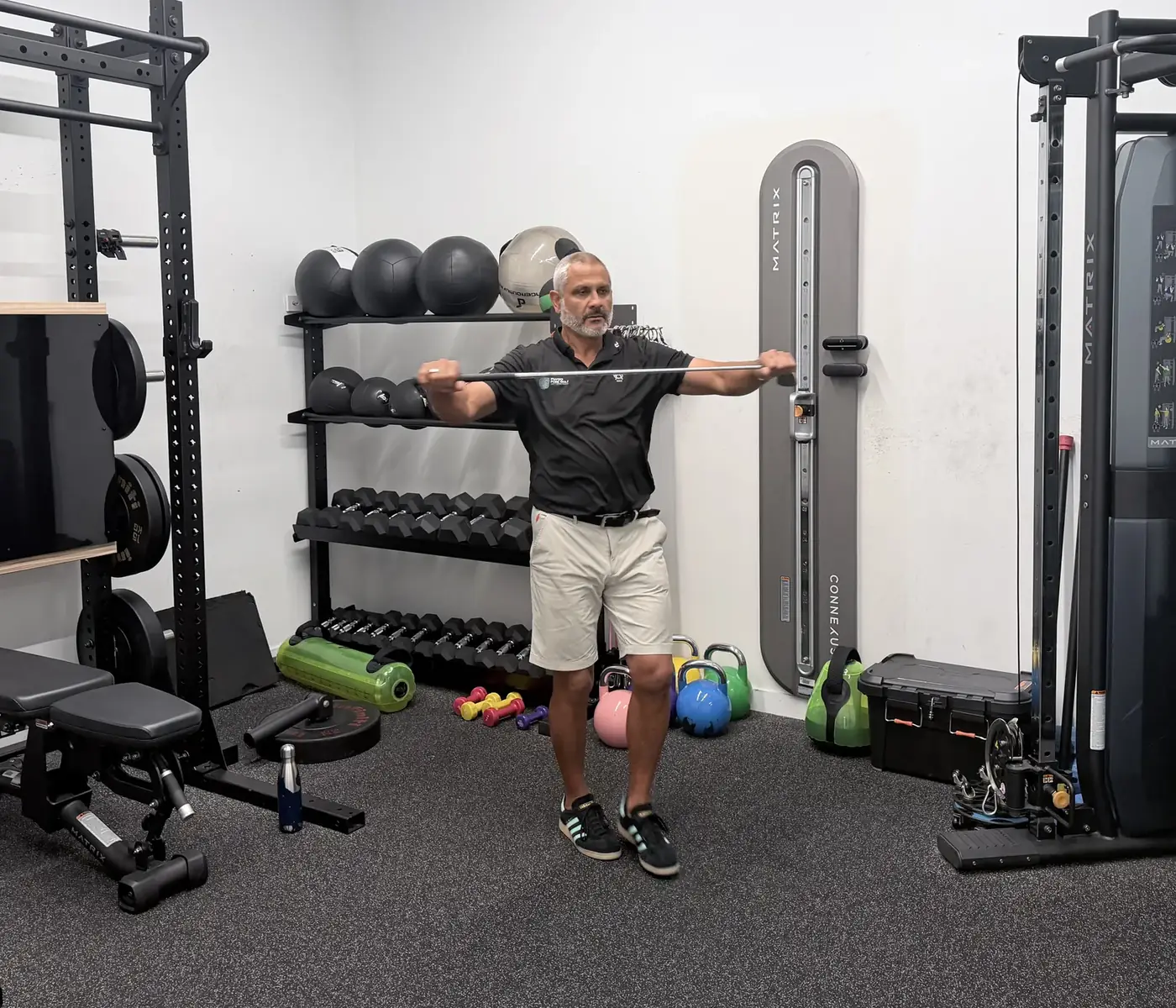

Take a wide grip on the club in front of you with arms stretched out.
Step forward and rotate the club into the lead leg, then repeat to the other side. Continuously walk while rotating the club into the front leg increasing upper back rotation as comfortable.
Do not force and gently get your trunk turning.
If you have shoulder pain, choose movements that do not aggravate it. Ongoing shoulder pain needs individual assessment rather than a harder stretch.
8. Finish With Progressive Practice Swings
8-12
swings
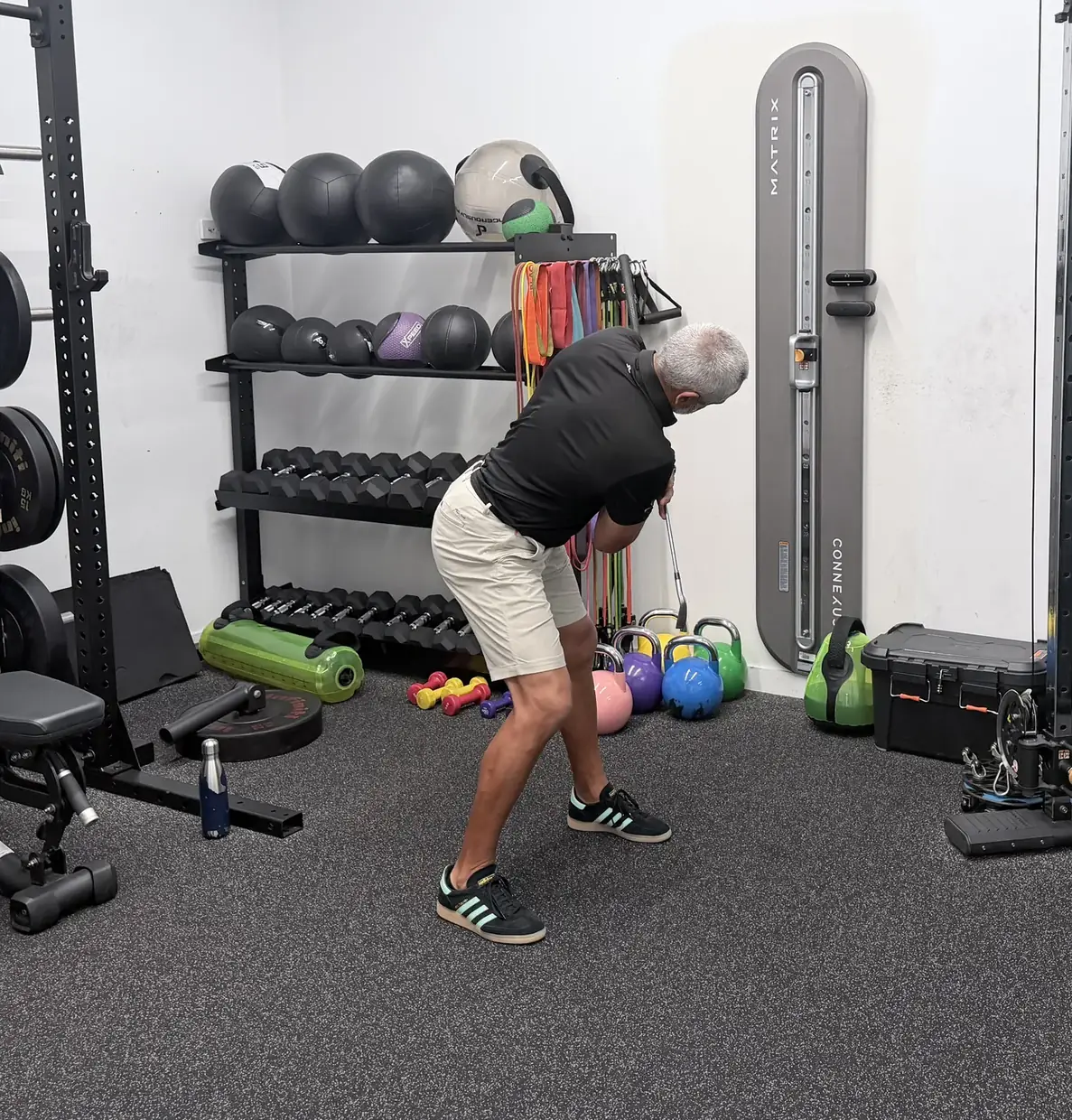
Start with a few easy half swings.
Move into three-quarter swings, then make a few full swings at your normal range. Add speed across the final swings if that suits what you plan to do on the course or range.
For example:
- 1Three half swings.
- 2Three three-quarter swings.
- 3Three full swings at a comfortable speed.
- 4Two or three swings closer to your playing speed.
This progression takes you from general movement into the task you are about to perform.
A study involving 23 highly skilled golfers found higher ball velocity after dynamic and resistance-band warm-ups than after the control condition. 3
Should You Stretch Before Golf?
You can include dynamic stretching in your golf warm-up, but I would give dynamic movement and progressive swings most of the available time. Static stretching is best reserved for post play recovery.
Golf-specific research favours that approach. Moran and colleagues compared dynamic stretching, static stretching and no stretching before five-iron shots. The dynamic stretching condition produced higher clubhead and ball speeds than the other two conditions. 2
Another study used a much longer protocol. Fifteen young male competitive golfers completed either an active dynamic warm-up or 20 minutes of passive static stretching followed by the same active warm-up. The static-stretch condition produced lower measures of clubhead speed, distance, accuracy and ball contact. 4
The duration matters. A wider systematic review found smaller performance effects when static stretches lasted less than 60 seconds per muscle group and larger reductions at 60 seconds or more. 5
What Is the Difference Between Golf Mobility Exercises and Golf Flexibility Exercises?
Flexibility describes the range available at a joint or across a muscle-tendon system. Mobility includes your ability to use and control movement through that range.
That difference matters in golf.
You might have plenty of hip range when someone moves your leg on a treatment table, yet struggle to control the same hip while you rotate in a golf posture.
For a pre-round warm-up, I favour active golf mobility exercises because you need to move and control your body during the swing.
Golf flexibility exercises can have a place in a longer-term programme when a golfer has a measured range-of-motion restriction. I would assess the restriction before deciding that more stretching is the answer.
How Long Should You Warm Up Before Golf?
Research has not established one ideal warm-up length for every golfer. I use 8 to 10 minutes as a practical target for a recreational round because it gives you time to move, rotate and make progressive swings.
Your routine can take longer if you have range access and want to work through several clubs.
A Three-Minute Golf Warm-Up
If you only have three minutes:
- 60 seconds: brisk walking, hip hinges and squats.
- 60 seconds: hip and upper-back rotations.
- 60 seconds: progressive practice swings.
Spend the final minute on the golf movement rather than squeezing in another four stretches.
Can Warming Up Reduce Golf Injury Risk?
We do not have strong golf-specific evidence that warming up reduces injury risk.
The systematic review of golf warm-ups found mixed and inconclusive evidence on the relationship between warm-up habits and golf-related injury. The research gave more support to acute performance effects than injury reduction. 1
I still see value in preparing your body before playing, but I would not tell a golfer that a 10-minute routine will prevent an injury.
Playing and practice volume, previous injury, strength, physical capacity and recovery can all matter. Your warm-up covers one small part of that picture.
What If You Feel Stiff Every Time You Play?
If the same restriction appears every round, I would want to measure it rather than keep adding exercises.
For example, I might look at:
- Hip rotation and control.
- Upper-back rotation.
- Shoulder movement.
- Strength and power.
- Balance.
- Your current playing and practice load.
A golfer who needs 25 minutes of mobility work before every round may have a different problem from a golfer who feels a little stiff after sitting in the car.
The exercise list cannot tell us which physical quality limits you.
Should Your Warm-Up Change If You Want More Clubhead Speed?
Yes. Give the final part of your warm-up more emphasis on progressive swing speed.
Start below your maximum speed and build across several swings. Do not go from slow hip rotations into an all-out driver.
Warm-up research has found short-term changes in golf performance measures after dynamic and resistance-based protocols. Longer-term changes in clubhead speed depend on physical qualities such as strength and power as well as golf technique. 3
I cover the training side in my guide to how to increase clubhead speed.
A Practical Warm-Up Before Your Next Round
Give yourself 8 to 10 minutes before the first tee. Start with whole-body movement, work through the hips, trunk and shoulders, then spend the final few minutes building your golf swing.
Keep the routine short enough that you will use it.
If you keep finding the same restriction, pain or loss of movement, I would assess the problem before adding more stretches. At Physio Fore Golf in Sydney, I work with golfers on injury assessment, physical screening and performance so we can measure the relevant physical qualities and decide what needs attention.
General Information Only
This article contains general educational information. It does not provide an individual diagnosis or treatment plan.
References
- 1Ehlert A, Wilson PB. A Systematic Review of Golf Warm-ups: Behaviors, Injury, and Performance. J Strength Cond Res. 2019. PMID: 31469762.
- 2Moran KA, McGrath T, Marshall BM, Wallace ES. Dynamic stretching and golf swing performance. Int J Sports Med. 2009. PMID: 19177316.
- 3Langdown BL, Wells JET, Graham S, Bridge MW. Acute effects of different warm-up protocols on highly skilled golfers' drive performance. J Sports Sci. 2019. PMID: 30326790.
- 4Gergley JC. Acute effects of passive static stretching during warm-up on driver clubhead speed, distance, accuracy, and consistent ball contact in young male competitive golfers. J Strength Cond Res. 2009. PMID: 19387392.
- 5Behm DG, Blazevich AJ, Kay AD, McHugh M. Acute effects of muscle stretching on physical performance, range of motion, and injury incidence in healthy active individuals: a systematic review. Appl Physiol Nutr Metab. 2016. PMID: 26642915.
- 6Sheehan WB, Bower RG, Watsford ML. Physical Determinants of Golf Swing Performance: A Review. J Strength Cond Res. 2022. PMID: 31868818.
- 7Bourgain M, Rouch P, Rouillon O, Thoreux P. Golf Swing Biomechanics: A Systematic Review and Methodological Recommendations for Kinematics. Sports (Basel). 2022. PMID: 35736831.
Frequently Asked Questions
How long should you warm up before golf?
I use 8 to 10 minutes as a practical target for a recreational round, because that gives you time to move, rotate and make progressive swings. Research has not established one ideal warm-up length for every golfer, and your routine can take longer if you have range access and want to work through several clubs.
Should you stretch before golf?
Dynamic stretching, yes. Static stretching is better kept for after you play. In one study comparing dynamic stretching, static stretching and no stretching before five-iron shots, the dynamic condition produced the higher clubhead and ball speeds. Longer static stretches show the largest reductions, at 60 seconds or more per muscle group.
What is the best golf warm-up if I only have three minutes?
Sixty seconds of brisk walking, hip hinges and squats. Sixty seconds of hip and upper-back rotations. Sixty seconds of progressive practice swings. Spend that final minute on the golf movement rather than squeezing in another four stretches.
Will warming up stop me getting injured playing golf?
There is no strong golf-specific evidence that it will. The systematic review of golf warm-ups found mixed and inconclusive evidence on warm-up habits and golf injury, with more support for acute performance effects. Playing and practice volume, previous injury, strength and recovery all matter, and your warm-up covers one small part of that picture.
What is the difference between golf mobility and golf flexibility exercises?
Flexibility is the range available at a joint. Mobility includes your ability to use and control movement through that range. You might have plenty of hip range on a treatment table and still struggle to control the same hip while rotating in a golf posture, which is why I favour active mobility work before a round.
Should my warm-up change if I want more clubhead speed?
Yes. Give the final part more emphasis on progressive swing speed, starting below your maximum and building across several swings. Do not go from slow hip rotations into an all-out driver. Longer-term clubhead speed still depends on strength, power and technique rather than the warm-up itself.
Related Service
Golf Fitness Screening
You would not rebuild a swing without knowing what your body can and cannot do. A golf fitness screening gives you that picture.
Explore Golf Fitness ScreeningSummarise This Article With AI
Open in your favourite assistant for a quick summary.