AI Overview
The best exercises for golfer's elbow usually involve gradually strengthening the wrist flexors and forearm, rebuilding grip capacity, and then progressing towards the loads required during the golf swing. Eccentric wrist flexion is particularly useful because it loads the tendon on the inside of the elbow in a controlled way. There is not one exercise that works for every golfer — the right starting point depends on how irritable your elbow is, what currently aggravates it, and how much golf, gym training and other loading you are asking it to tolerate.
Key Highlights
- No single exercise fixes golfer's elbow. A programme that progressively builds capacity does.
- Eccentric wrist flexion loads the tendon in a controlled way and is usually a mainstay.
- Grip capacity matters more than maximum grip strength, because golf is repeated gripping.
- The most useful check is the next morning, not how the exercise felt at the time.
- Change one or two variables at a time so you can read the elbow's response.
- Rehab is not finished at the point the pain settles. It finishes when you can play your normal golf.
The best exercises for golfer's elbow usually involve gradually strengthening the wrist flexors and forearm, rebuilding grip capacity and then progressing towards the loads required during the golf swing.
Eccentric wrist flexion is particularly useful because it loads the tendon on the inside of the elbow in a controlled way. Forearm rotation, grip strengthening and mobility work can also form part of a progressive programme.
There is not one exercise that works for every golfer. The right starting point depends on how irritable your elbow is, what currently aggravates it and how much golf, gym training and other loading you are asking it to tolerate.
Quick Summary
If I am building an exercise programme for golfer's elbow, the main areas I am likely to consider are:
- Wrist and forearm mobility
- Isometric wrist flexion where a lower-load starting point is useful
- Slow eccentric wrist flexion
- Forearm pronation and supination
- Progressive grip strengthening
- Gradual exposure to golf-specific gripping, rotation and impact
- Managing practice, playing and gym load while capacity improves
A 2026 systematic review specifically examining eccentric exercise for medial epicondylitis included five studies and 143 patients. The authors found improvements in pain and function across the included studies, but also concluded that the overall certainty of the evidence remains low because the studies were small and used different protocols.
Exercises Are Tools, Not Recipes
I would rather assess what the golfer can currently tolerate and progress from there than give every golfer exactly the same programme.
What Is Golfer's Elbow?
Golfer's elbow, or medial epicondylitis, is a tendinopathy affecting the flexor-pronator tendon attachment on the inside of the elbow.
These muscles help bend the wrist, grip and rotate the forearm. All three actions matter in golf.
You may notice pain or tenderness around the inside of the elbow when you:
- Grip a club
- Bend the wrist forwards
- Rotate the forearm
- Carry something heavy
- Perform pulling or gripping exercises
- Hit balls from a firm mat
- Catch the ground heavily during a shot
If you want more detail on the condition itself, our golfer's elbow guide explains the symptoms, contributing factors and how golf can load the area.
Pain in this region does not automatically mean you have golfer's elbow. Other elbow and nerve problems can produce symptoms in a similar area, which is one reason I would not diagnose it from symptoms alone online.
What Are the Best Exercises for Golfer's Elbow?
There is no single best golfer's elbow exercise. A good programme progressively builds the capacity of the muscles and tendon around the inside of the elbow.
The American Academy of Orthopaedic Surgeons includes stretching, staged wrist flexion strengthening, forearm rotation and grip work within its exercise programme for medial and lateral epicondylitis.
These are five exercises I would commonly consider.
1. Wrist Flexor Stretch
The muscles that flex the wrist run along the palm side of the forearm and attach around the inside of the elbow.
A gentle stretch can help maintain movement through this area.
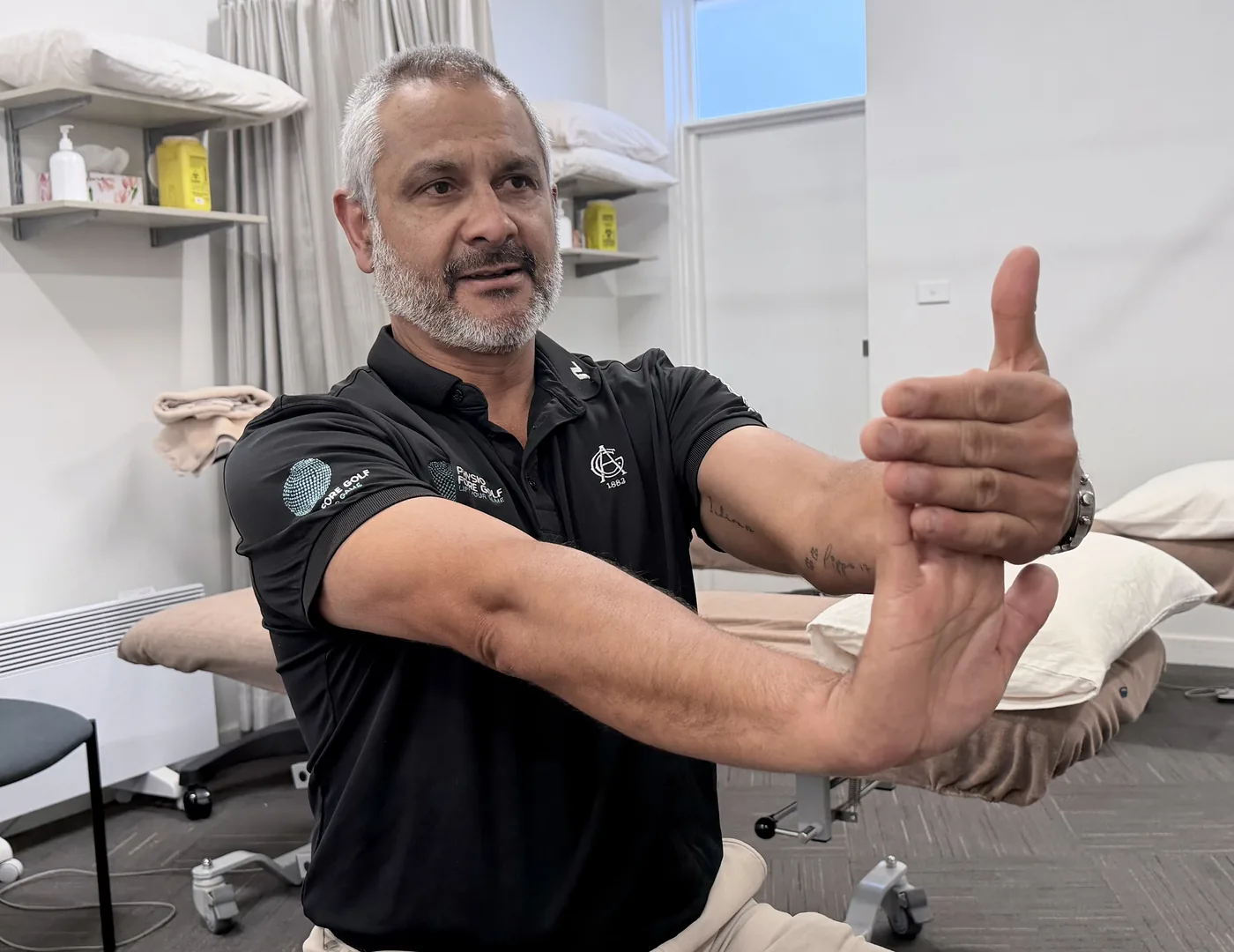
How to Do It
- 1Straighten your arm in front of you.
- 2Turn your palm upwards.
- 3Use your other hand to gently pull the fingers and wrist backwards.
- 4You should feel a stretch along the inside of the forearm.
- 5Keep the shoulder relaxed and avoid forcing the elbow completely straight if that feels uncomfortable.
The AAOS exercise programme uses a 15-second hold repeated five times for this type of forearm stretch.
The important word is gentle.
Pulling harder because you can feel the painful area more strongly does not necessarily make the exercise more useful.
I also would not rely on stretching alone. Golfer's elbow ultimately involves a tendon that needs to tolerate load, so strengthening usually becomes the bigger part of the programme.
2. Isometric Wrist Flexion
An isometric exercise creates force without much movement at the joint.
It can be a useful way to introduce load when moving the wrist through a larger range is uncomfortable.
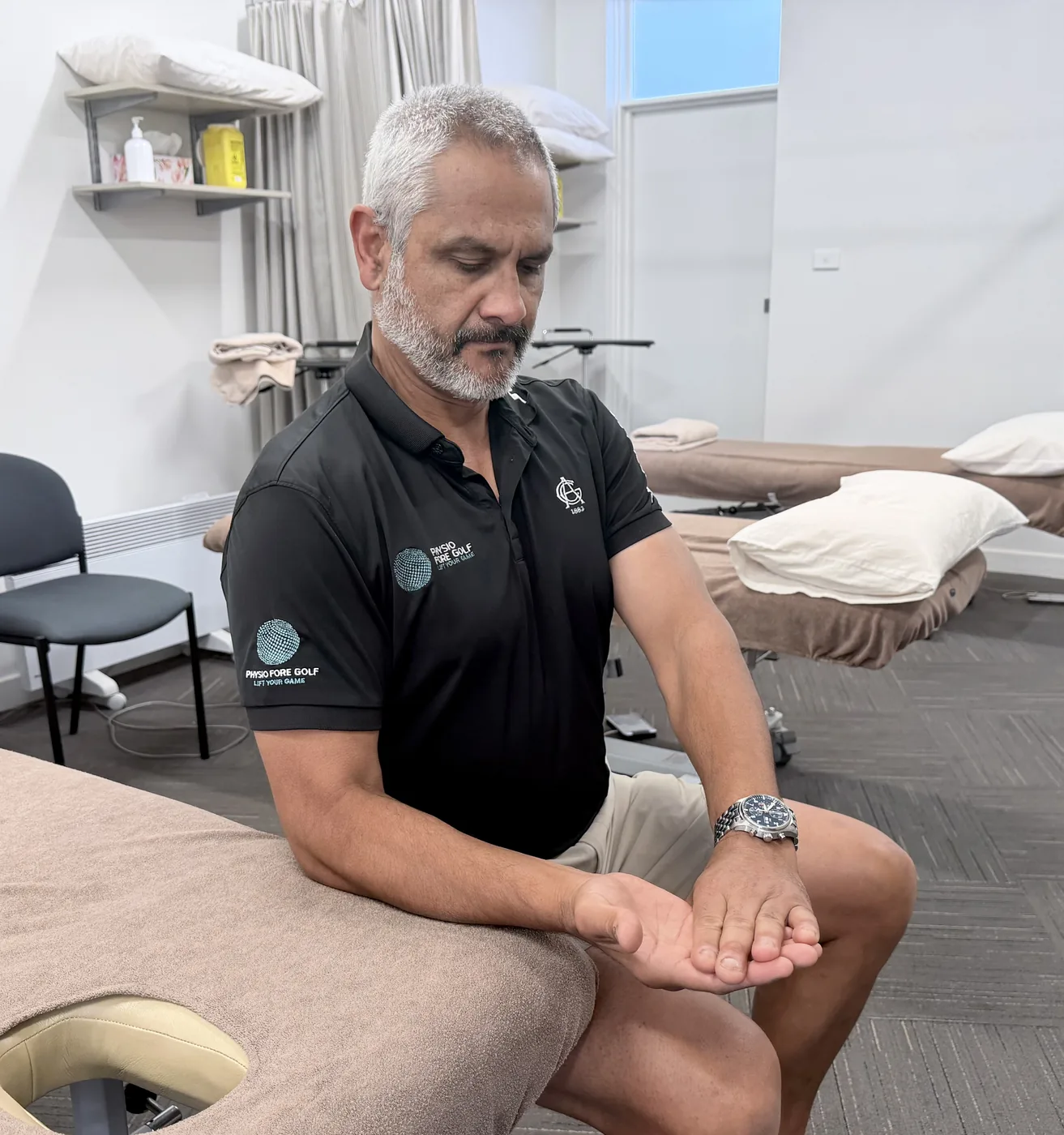
How to Do It
- 1Rest your forearm on a table with the palm facing upwards.
- 2Keep your wrist in a comfortable position.
- 3Place your other hand against the palm.
- 4Try to bend your affected wrist upwards.
- 5Use the other hand to provide enough resistance that the wrist stays still.
- 6Hold the effort, then relax.
The amount of force matters more than simply trying to squeeze as hard as possible.
I would normally choose a resistance that gives the forearm something meaningful to work against without producing a large increase in symptoms.
From there, the exercise can be made progressively harder before moving into more dynamic wrist strengthening.
3. Eccentric Wrist Flexion
Eccentric wrist flexion is one of the main golfer's elbow strengthening exercises I would consider.
An eccentric contraction occurs when a muscle produces force while it is lengthening.
In practical terms, you are slowly lowering the wrist against resistance.
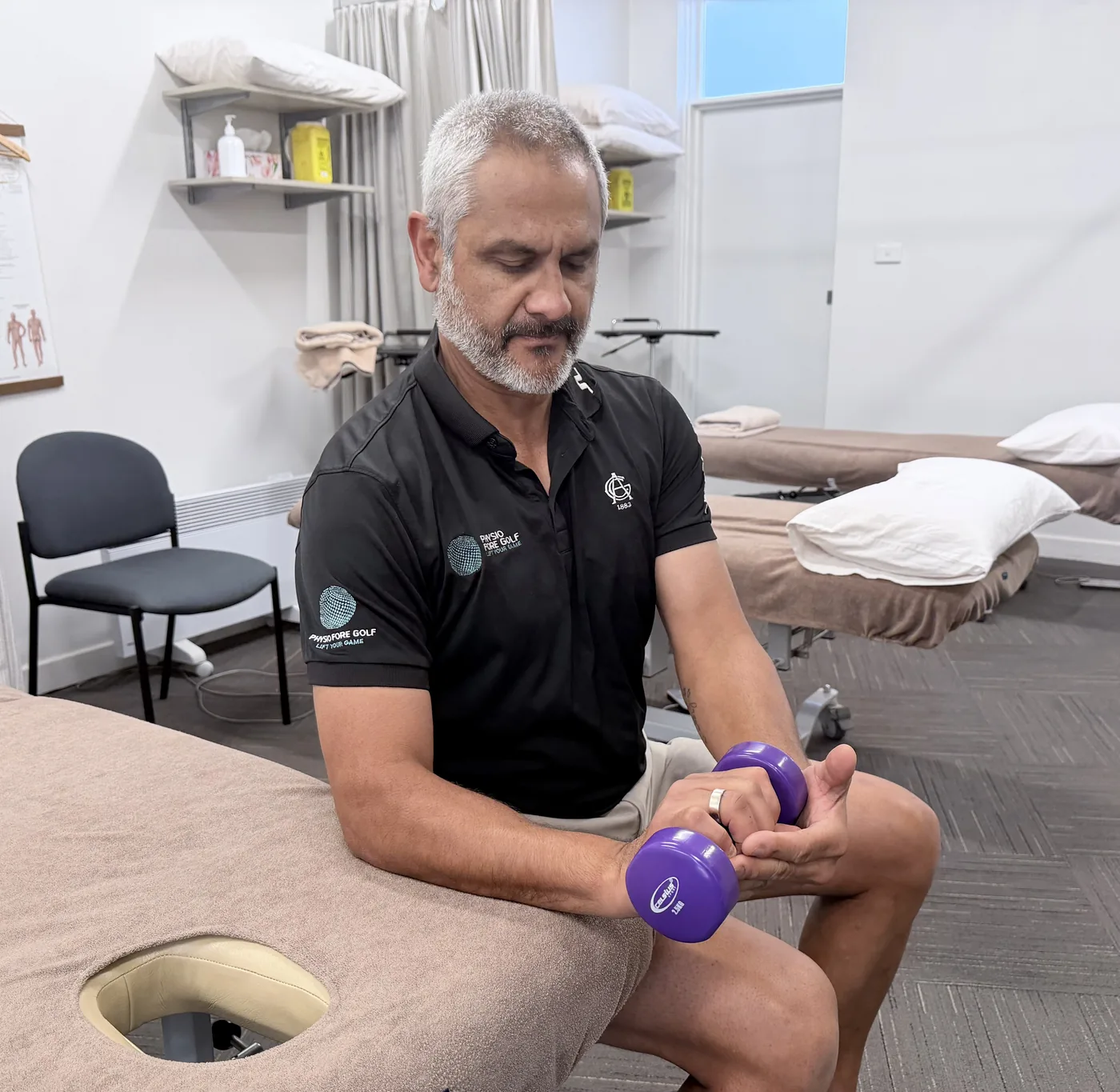
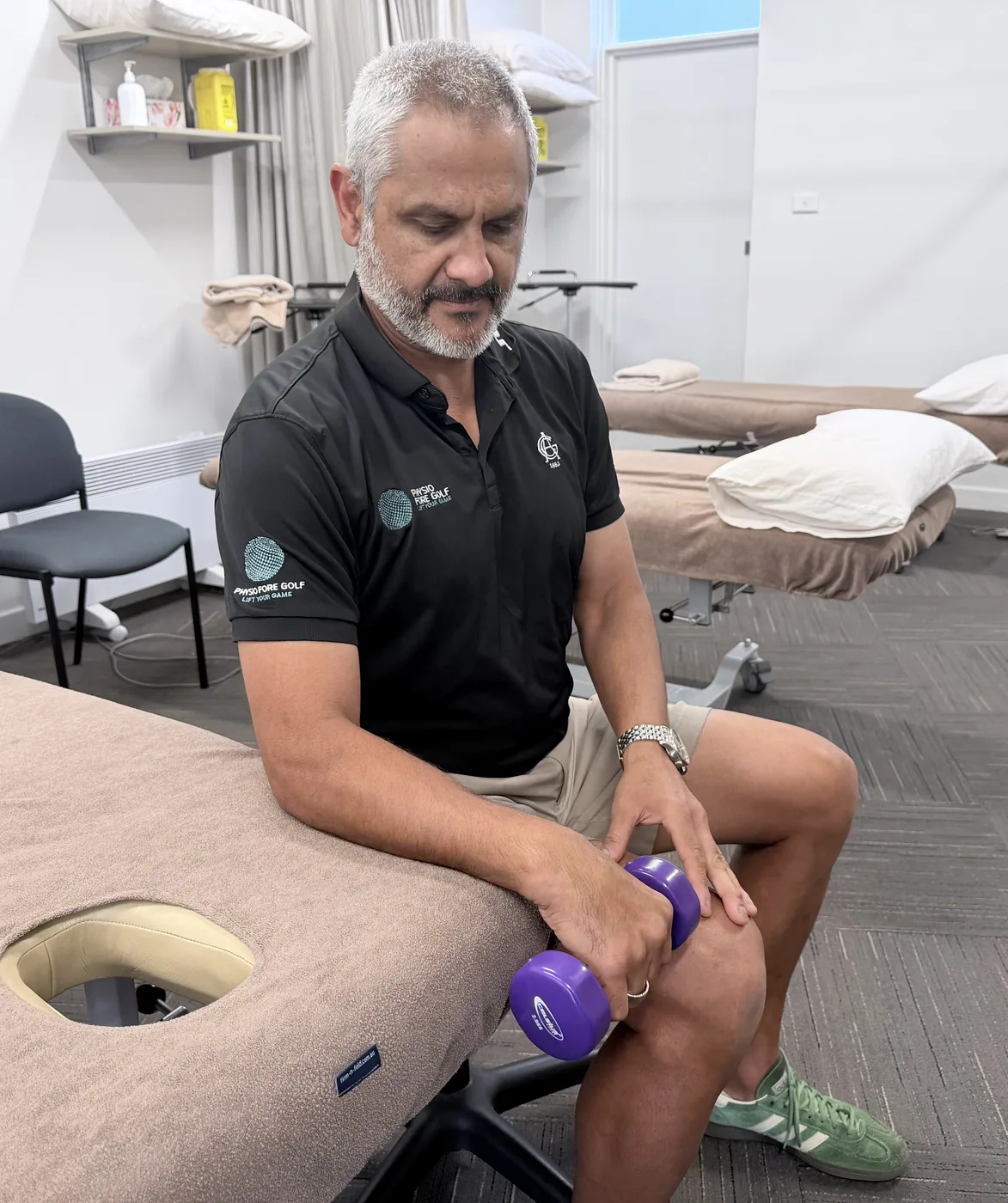
How to Do It
- 1Sit with your forearm supported on a table or bench.
- 2Let your hand hang over the edge with the palm facing upwards.
- 3Hold a light dumbbell.
- 4Use your other hand to help lift the affected wrist upwards.
- 5Take the supporting hand away.
- 6Slowly lower the weight using the affected wrist.
- 7Use your other hand to return it to the starting position.
The AAOS programme uses a slow three-count lowering phase and progresses the exercise from no weight through increasingly heavier resistance once repetitions can be completed without increasing pain.
The exact weight is less important than how well you control it.
If You Have to Rush the Lower, It Is Too Heavy
If you have to drop the wrist quickly or move the whole arm to manage the weight, it is probably too heavy for the purpose of the exercise.
Why Does Eccentric Exercise Get so Much Attention?
Eccentric exercise has been used extensively in tendon rehabilitation, although the evidence specifically for golfer's elbow is much smaller than the evidence base for some other tendinopathies.
The 2026 systematic review of eccentric exercise for medial epicondylitis found that it may reduce pain and improve function, particularly when included within broader conservative rehabilitation. However, the researchers rated the overall certainty of the evidence as low.
So I would see eccentric wrist flexion as a useful loading option rather than a guaranteed solution.
4. Forearm Pronation and Supination
Your forearm also has to rotate.
Pronation turns the palm down. Supination turns the palm up.
That movement matters in golf because the hands and forearms rotate throughout the swing.
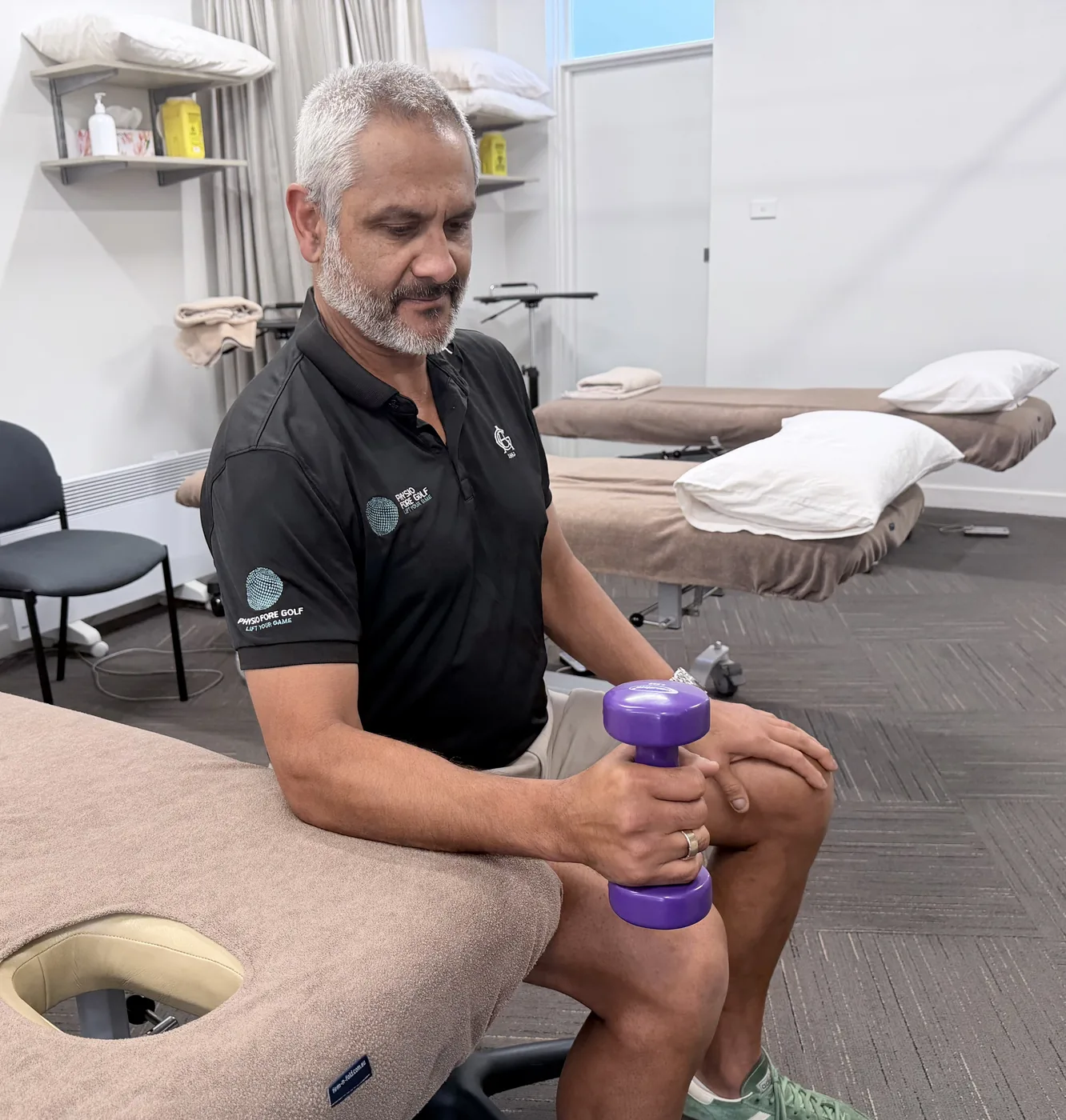
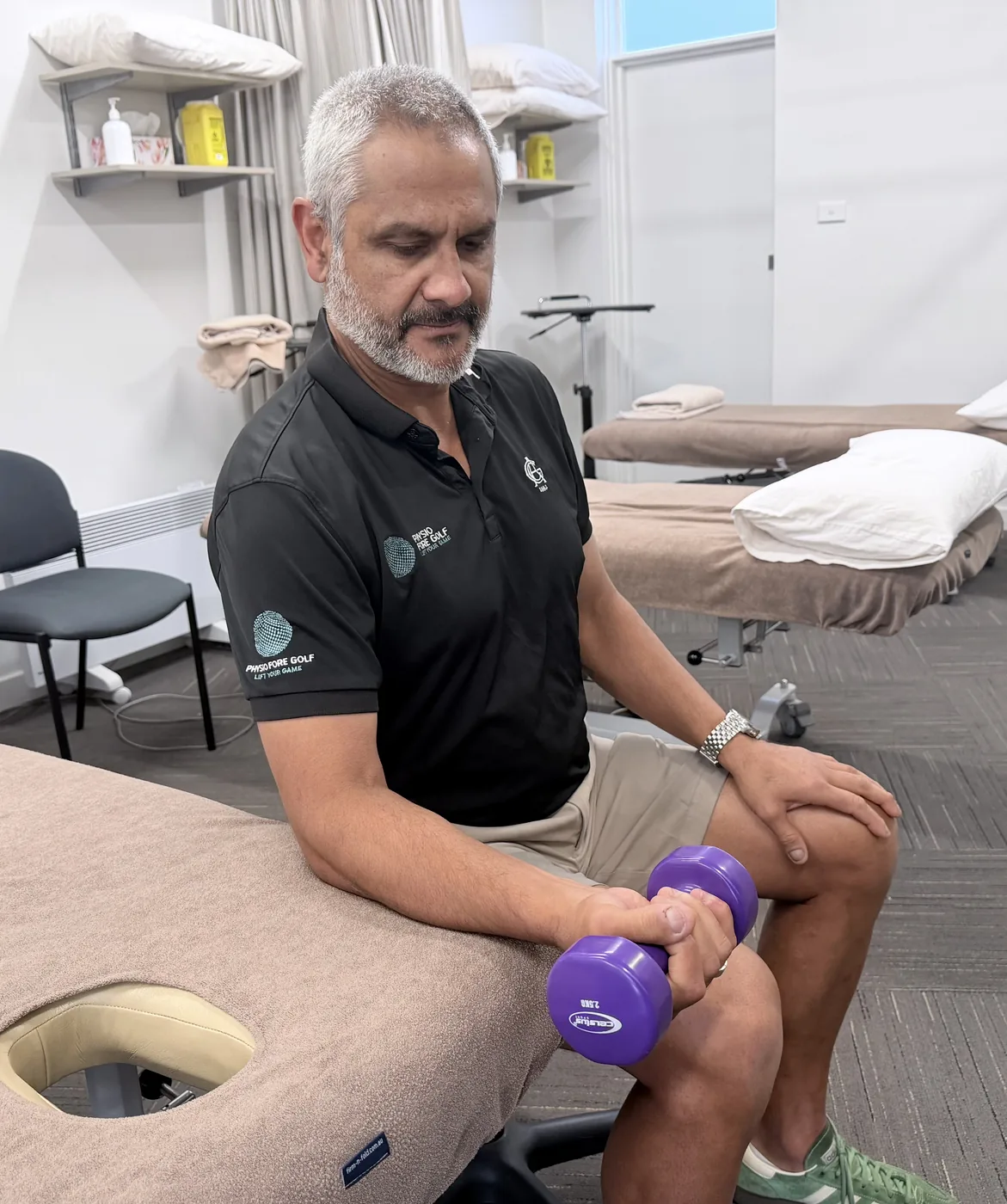
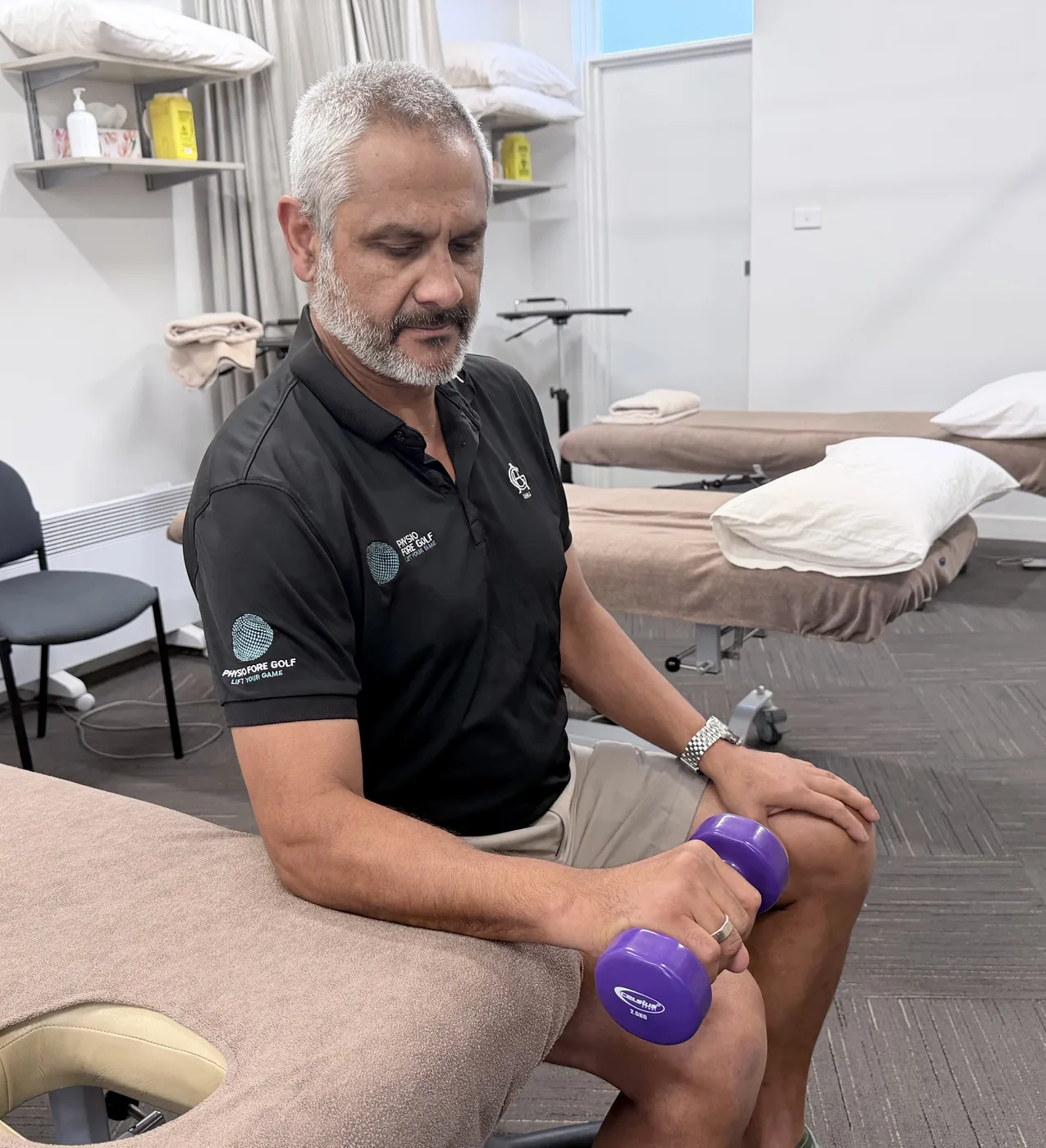
How to Do It
You can use a light dumbbell, hammer or similar object.
- 1Bend your elbow to around 90 degrees.
- 2Keep your elbow close to your side.
- 3Hold the weight with your palm facing sideways.
- 4Slowly rotate until the palm faces upwards.
- 5Return to the middle.
- 6Slowly rotate until the palm faces downwards.
- 7Return to the starting position.
Keep the movement slow and controlled.
The AAOS epicondylitis programme also includes staged forearm pronation and supination strengthening, progressing the resistance once the exercise can be completed without an increase in pain.
Move Your Grip, Not the Weight
A useful way to make the exercise harder without adding much weight is to use something long, such as a hammer. Holding it close to the centre is easier. Moving your grip towards the end increases the lever and makes the forearm work harder.
5. Grip Strengthening
Grip training deserves specific attention for golfers.
You have to grip the club for every shot, but golf does not require one maximum-effort squeeze. The forearm needs to tolerate repeated gripping through warm-up, practice and a round.
That means I am interested in grip capacity, not simply how hard someone can squeeze once.
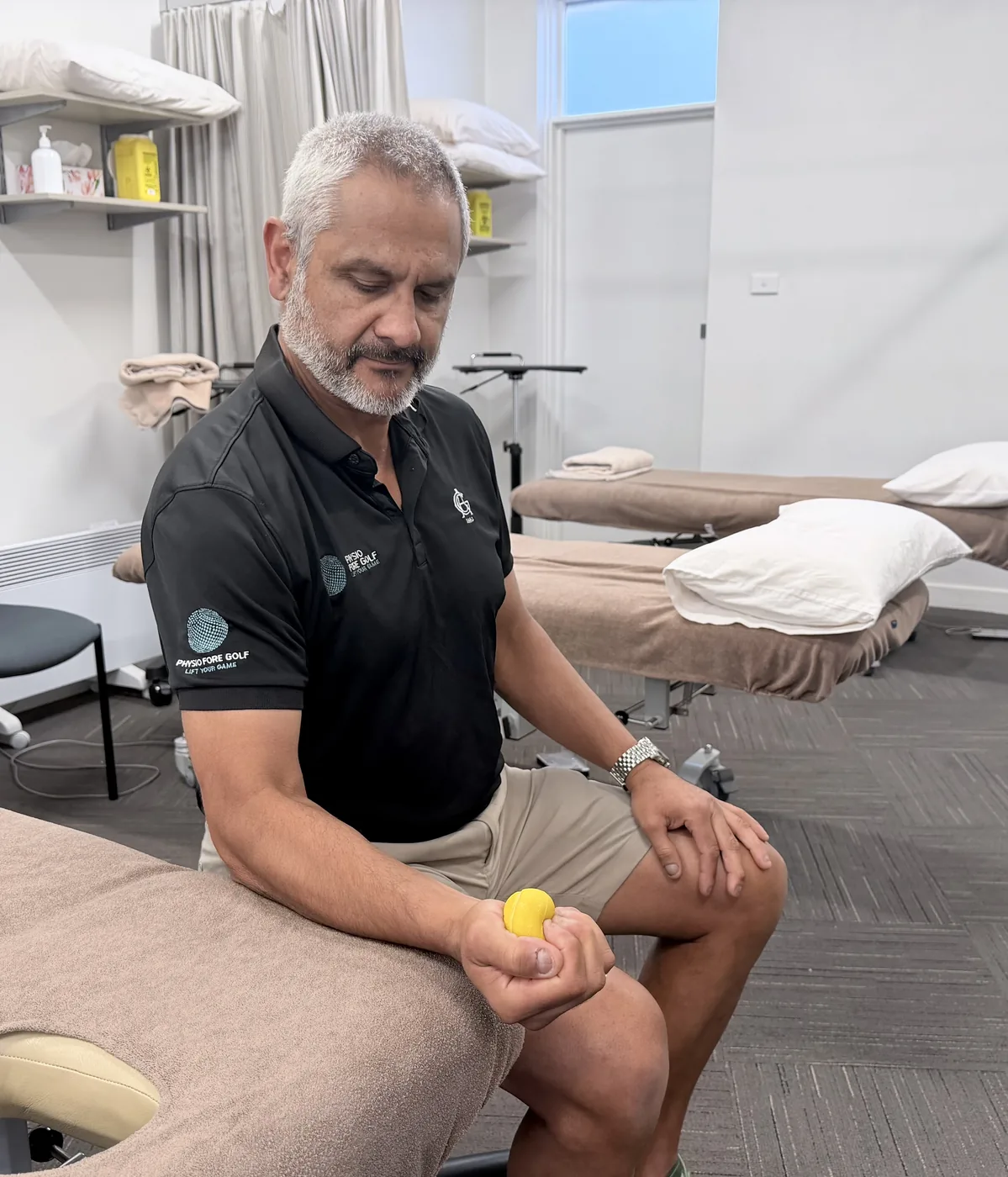
How to Do It
A stress ball, soft ball or rolled towel can work well.
- 1Hold the object with the wrist in a comfortable position.
- 2Gradually squeeze it.
- 3Hold briefly.
- 4Relax fully.
- 5Repeat.
The AAOS programme includes a stress-ball squeeze after the earlier staged strengthening work.
From there I would gradually increase the challenge depending on what the golfer needs. That might involve:
- Stronger squeezes
- Longer holds
- More repetitions
- Longer total gripping time
- Holding a golf club
- Progressing towards golf-specific movements
The goal is eventually to make the forearm capable of handling golf again.
How Hard Should Golfer's Elbow Exercises Be?
The exercises need to provide enough load to challenge the forearm without repeatedly aggravating the elbow beyond what it can tolerate.
One of the most useful things I look at is how the elbow responds over time, not just whether an exercise hurts while you are doing it.
I would look at three points.
- 01
During the Exercise
Some discomfort can occur during tendon loading, but sharp or rapidly increasing pain is a good reason to reduce the resistance, range or volume.
- 02
Later That Day
The elbow should not become progressively more irritable every time you perform your exercises.
- 03
The Next Morning
Often the most useful check. An exercise may feel perfectly manageable while you are doing it. If gripping a coffee cup, opening a door or moving your wrist is clearly worse the following morning, you may have progressed the load too quickly.
That gives us information we can use to adjust the programme.
How Do You Progress Golfer's Elbow Exercises?
Progressive loading means gradually increasing what the elbow is being asked to tolerate. That might involve changing:
- Resistance
- Repetitions
- Sets
- Range of movement
- Speed
- Grip demand
- Exercise frequency
- Total weekly loading
I usually prefer changing one or two things at a time rather than suddenly making every part of the programme harder.
It makes the response much easier to interpret.
For example, if you have been using a light dumbbell comfortably for wrist flexion, the next step might simply be a slightly heavier weight.
It does not also need to become twice as many repetitions, twice as many sessions and a full range session on the same day.
What Exercises Should You Avoid with Golfer's Elbow?
There is no universal list of exercises everyone with golfer's elbow must avoid.
The better question is: which exercises currently exceed what your elbow can tolerate?
Common aggravating exercises can include:
- Heavy wrist curls
- Heavy bicep curls
- Pull-ups and chin-ups
- Heavy rows
- High-volume gripping work
- Loaded carries
- Repeated forearm training
That does not make those exercises inherently bad.
If you can perform rows with no meaningful increase in symptoms during or after the session, I would not automatically remove them simply because you have golfer's elbow.
If every set makes your elbow progressively worse and you are still more sore the following morning, something probably needs changing. You might reduce:
- The weight
- The number of sets
- The number of repetitions
- Grip intensity
- Range of movement
- Frequency
This is often more useful than stopping all upper-body exercise for weeks.
Can You Still Play Golf While Doing Golfer's Elbow Exercises?
Some golfers can continue playing while rehabilitating golfer's elbow, provided their current golf load is something the elbow can tolerate.
Others need to reduce their playing or practice volume temporarily. The answer depends on the individual.
For more detail, I have covered this separately in our guide to golfing with golfer's elbow.
The key distinction I make is between “Can I hit a golf ball?” and “Can my elbow handle my normal amount of golf?” They are different questions.
You might be able to hit ten comfortable shots but become increasingly sore after 80 range balls. Likewise, nine holes may be manageable while 18 holes plus a long warm-up currently exceeds the elbow's capacity.
Possible short-term modifications can include:
- Playing nine rather than 18 holes
- Reducing range volume
- Hitting fewer full-speed shots
- Breaking practice into shorter blocks
- Reducing the number of rounds in a week
- Limiting repetitive shots from firm mats
The aim is not necessarily zero golf. It is finding an appropriate amount of golf while the elbow's capacity is being rebuilt.
How Should You Return from Exercises to Hitting Golf Balls?
A forearm exercise and a golf swing place very different demands on the body. Golf adds speed, grip force, rotation, impact and repetition.
That means I would normally build those demands back progressively.
- 01
Stage 1: Restore Basic Forearm Capacity
Start with appropriate wrist, forearm and grip exercises.
- 02
Stage 2: Introduce the Club
Practise gripping and moving a club without large volumes of ball striking.
- 03
Stage 3: Short Game
Putting, chipping and controlled pitch shots can introduce golf-specific load at lower intensity.
- 04
Stage 4: Partial Swings
Progress towards half and three-quarter swings while keeping the number of shots sensible.
- 05
Stage 5: Full Swings
Gradually increase full-swing speed and volume.
- 06
Stage 6: Normal Golf Workload
Build towards the amount of practice and play you actually want your elbow to tolerate.
This last stage is easy to overlook.
The aim of rehabilitation is not to become good at wrist curls. It is to build enough capacity for the things you actually want to do. For a golfer, that means golf.
How Long Should You Do Golfer's Elbow Exercises?
Golfer's elbow rehabilitation is generally better thought about in weeks rather than days.
There is no reliable single recovery time that applies to every golfer.
A recent review of medial epicondylitis describes graduated strengthening as an important part of conservative management, but how quickly someone progresses depends on their presentation and the loads they are returning to.
Factors I would consider include:
- How long the elbow has been painful
- How irritable it is
- Current forearm and grip strength
- Practice volume
- Playing frequency
- Gym training
- Work demands
- Previous elbow problems
- How consistently loading can be progressed
I would rather use the elbow's response and physical capacity to guide progression than simply decide that a particular number of weeks has passed.
Why Does Golfer's Elbow Keep Coming Back?
Recurring elbow pain can occur when symptoms settle but the forearm has not rebuilt enough capacity for the golfer's normal workload.
A common pattern is:
- 1The elbow becomes painful.
- 2Golf and training are reduced.
- 3The symptoms settle.
- 4Normal golf resumes immediately.
- 5The same amount of load is suddenly back on the elbow.
The missing part is often rebuilding the bridge between feeling better and being physically ready for normal golf.
This does not mean every golfer with recurring elbow pain has the same problem. When I assess someone, I may also look at:
- Wrist strength
- Forearm rotation
- Grip capacity
- Elbow movement
- Shoulder strength
- Practice volume
- Changes in playing frequency
- Gym training
- Work-related loading
- Which golf movements aggravate symptoms
The body is part of the swing, so I do not want to look at the sore spot in isolation if something else is relevant to the golfer's overall loading.
You can also see our overview of common golf injuries for other areas commonly affected by the physical demands of the game.
Is Golfer's Elbow the Same as Tennis Elbow?
No. Golfer's elbow generally affects the inside of the elbow, while tennis elbow affects the outside.
They involve different tendon attachments, although both can be aggravated by gripping and repetitive forearm loading.
If your pain is mainly on the outside of the elbow, our tennis elbow guide may be more relevant.
If you are unsure which structure is causing your symptoms, assessment is more useful than choosing exercises based on the name of the condition alone.
When Should Elbow Pain Be Assessed?
Elbow pain is worth assessing when the diagnosis is unclear, symptoms keep returning or the problem is limiting your ability to grip, practise or play.
I would also recommend seeking appropriate medical or physiotherapy assessment if you have:
- Significant or increasing weakness
- Numbness or pins and needles
- Significant swelling
- A sudden traumatic injury
- A sudden loss of function
- Symptoms that continue to worsen despite sensible load modification
- Persistent pain that is not responding as expected
Exercises Found Online Cannot Diagnose You
They cannot tell you exactly which structure is causing your pain. If the diagnosis is unclear, that is the thing worth sorting out first.
What Would I Assess in a Golfer with Elbow Pain?
If a golfer comes in with pain around the inside of the elbow, I do not start by handing them a standard sheet of exercises.
I want to understand the problem first. Depending on the presentation, I may assess:
- Where the symptoms are coming from
- What movements reproduce them
- Wrist and elbow movement
- Resisted wrist flexion
- Forearm rotation
- Grip strength and tolerance
- Current golf volume
- Recent changes in practice
- Gym and work loading
- Which shots or golf movements aggravate the elbow
Then we can decide what needs to be trained.
For one golfer, the biggest issue may be low forearm capacity after a long period of reduced activity. For another, strength may be reasonable but the elbow is being exposed to a sudden increase in practice volume.
The exercises should reflect that difference. Assess first, then prescribe.
The Key to Golfer's Elbow Exercises Is Progressive Loading
The best exercises for golfer's elbow generally aim to rebuild wrist, forearm and grip capacity progressively rather than relying on rest or stretching alone.
Start with a level the elbow can tolerate. Build strength gradually. Pay attention to the response later that day and the following morning. Then begin introducing more of the gripping, rotation, speed and impact required for golf.
Most importantly, make the programme match the golfer.
If elbow pain is affecting your practice or play and you are unsure what to train, a golf injury assessment at my Sydney golf physio clinic can help identify the contributing factors and establish an appropriate plan.
General Information Only
This article provides general educational information and is not an individual diagnosis or treatment programme.
References
- 1See ZH, Loo CE, Jaafar Z. Eccentric exercise therapy for medial epicondylitis: A systematic review of clinical outcomes. Complementary Therapies in Medicine. 2026;98:103364. PMID: 41887339.
- 2American Academy of Orthopaedic Surgeons. Therapeutic Exercise Program for Epicondylitis (Tennis Elbow / Golfer's Elbow). OrthoInfo.
- 3Medial Epicondylitis: A Review of Clinical Presentation, Diagnosis, and Management in the United Kingdom. 2026. PMID: 41742972.
Frequently Asked Questions
What is the best exercise for golfer's elbow?
There is not one. Eccentric wrist flexion is usually a mainstay because it loads the tendon in a controlled way, but a good programme also includes forearm rotation, grip work and a gradual return to golf-specific loading. The right starting point depends on how irritable your elbow currently is.
How hard should golfer's elbow exercises be?
Hard enough to challenge the forearm without repeatedly aggravating the elbow. The most useful check is the next morning: if gripping a coffee cup or opening a door is clearly worse than the day before, the load has probably been progressed too quickly.
Can I still play golf while doing these exercises?
Often yes, provided your current golf load is something the elbow can tolerate. The question is not whether you can hit a ball, it is whether your elbow can handle your normal amount of golf. Reducing range volume or playing nine instead of 18 is usually more useful than stopping entirely.
How long does golfer's elbow take to settle with exercise?
Think in weeks rather than days. There is no reliable single recovery time — it depends on how long the elbow has been painful, how irritable it is, your current strength, and the golf and gym loading you are returning to.
Why does my golfer's elbow keep coming back?
Usually because the symptoms settled but the forearm never rebuilt enough capacity for a normal golf workload. Pain going away and being physically ready for your usual volume of practice and play are two different things.
Is golfer's elbow the same as tennis elbow?
No. Golfer's elbow affects the inside of the elbow and tennis elbow affects the outside. They involve different tendon attachments, although both can be aggravated by gripping and repetitive forearm loading.
Related Service
Golf Injury Assessment
When something hurts, you want to know what it is, why it happened, and how to fix it. A golf injury assessment answers all three.
Explore Golf Injury AssessmentSummarise This Article With AI
Open in your favourite assistant for a quick summary.