AI Overview
A golf physical screen measures how your body moves so training targets the right limits. Restricted hip and thoracic rotation collapse the separation between your hips and shoulders, which is one of the biggest drivers of clubhead speed. Elite players screen before they train so every session earns distance instead of guessing, and it flags the compensations that lead to lower-back and elbow overload.
Key Highlights
- A screen measures mobility, stability, power and how your body sequences a swing.
- Limited hip and thoracic rotation reduces hip-shoulder separation and leaks clubhead speed.
- Tour-standard practice is to assess the body first, then prescribe, not the reverse.
- The screen also flags the compensations that overload the lower back, elbow and wrist.
- Results become a ranked plan of what to mobilise, stabilise and train for power.
- A screen is a snapshot, so re-testing shows whether the work is actually landing.
Most golfers train their bodies the same way they buy clubs. They copy what a pro does, or chase the drill that went viral this week.
The trouble is that your body is not the pro's body. A screen tells you what is actually holding your swing back, so you train the right thing.
This guide explains what a physical golf screen measures, how physical limits quietly cost you distance, and why every serious player screens before they train.
What a Golf Physical Screen Measures
A golf physical screen is a structured set of movement tests that check how your body performs the demands of a swing. It is not a swing lesson and it is not a scan of your clubs.
It looks at four things: how far you can move, how well you control that movement, how much force you can produce, and the order your body moves in. Weakness in any one of them shows up in the ball.
The Four Qualities a Screen Assesses
- Mobility: available range at the hips, thoracic spine, shoulders and wrists.
- Stability: your ability to control a joint and stay balanced under load.
- Power: how quickly you can produce rotational force, not just how strong you are.
- Sequencing: whether your body fires in the right order from the ground up.
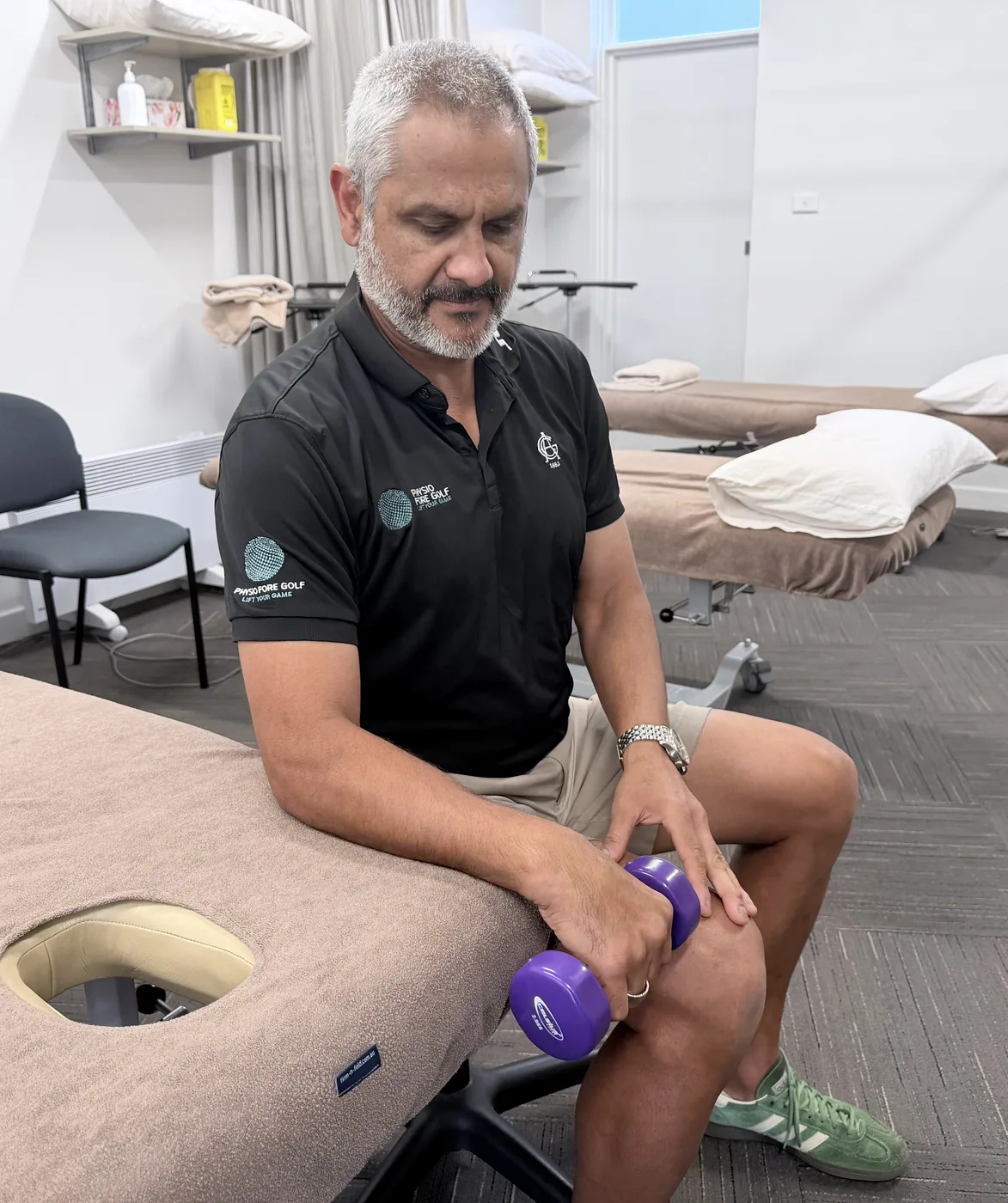
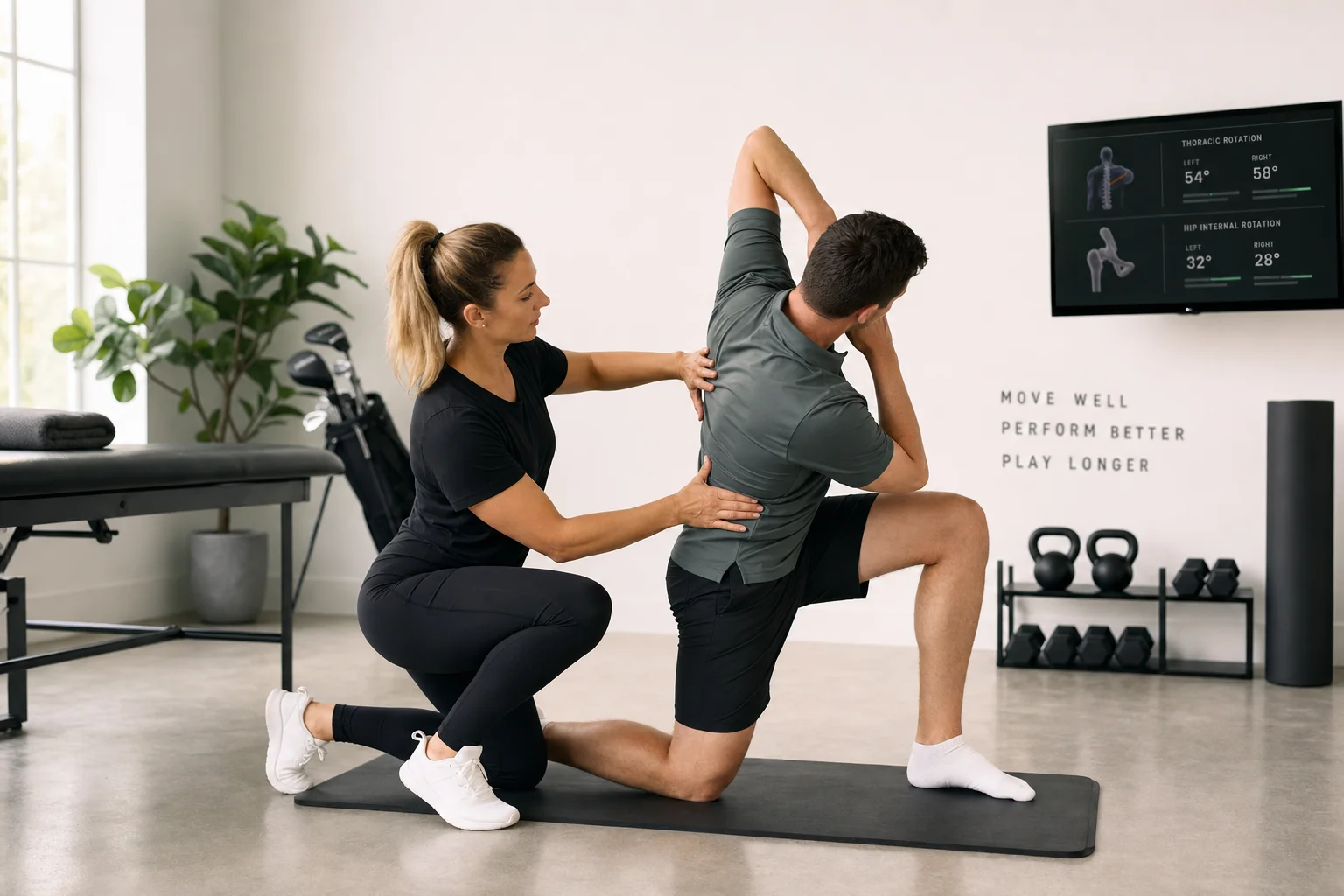
A common way to test overall movement is an overhead deep squat, which exposes ankle, hip and thoracic restrictions in one pattern. Rotation is checked separately, seated, to isolate the spine from the hips.
Screen it, don't guess it
Two golfers can lose distance for opposite reasons. One is stiff and needs mobility, the other moves plenty but leaks power through poor stability. A screen tells them apart before either wastes a season on the wrong work.
| Screen Test | What It Reveals | Why It Matters for Golf |
|---|---|---|
| Seated trunk rotation | Thoracic spine rotation, left and right | Feeds the shoulder turn and hip-shoulder separation |
| Hip rotation, internal and external | Rotational range at each hip | Lets you load and clear the trail and lead hip cleanly |
| Overhead deep squat | Whole-body mobility and core control | Screens the ankle, hip and spine links at once |
| Single-leg balance | Lower-limb stability and control | Underpins a stable base through impact |
| Rotational power throw | Speed of force production through the trunk | Closely tied to clubhead speed and carry |
Common screen tests and what each one reveals
How Physical Limitations Cost You Distance
Clubhead speed is not made in your arms. It is built from the ground, through your hips and trunk, and released into the club in a fraction of a second.
The single biggest engine is the separation between your hips and your shoulders at the top of the backswing. The more you can turn your chest while your hips stay stable, the more stretch you load into your trunk.
Why Rotation Range Is So Valuable
That stretch works like an elastic band. It stores energy that unloads through the downswing and adds speed for free, without swinging harder.
Research consistently links greater hip-shoulder separation, hip rotation range and rotational power to higher clubhead speed and longer carry. When any of those are restricted, the elastic band is short and there is less to release.
Up to 48%
of ball speed variation
linked to hip rotational flexibility in study data
0.5 to 0.8
correlation range
between rotational power, separation and clubhead speed
40 to 60%
of golfers
report discomfort or injury in a given year
Restriction does not just cost speed, it borrows from your joints
When your hips or mid-back cannot rotate far enough, your body finds the range elsewhere. It usually borrows from the lower back, the lead elbow or the wrist, which is why those areas are the most commonly injured in golf.
So a limitation is a double loss. You give up speed you could have, and you load tissue that was never built to make up the difference.
Why Pros Screen Before They Train
In elite sport, nobody prescribes training blind. The body is assessed first, then the program is built around what it finds.
The logic is simple. A gym program that ignores your specific limits can make you stronger in the very positions that are already holding your swing back.
Assess first, then prescribe. Guessing at the body is how good golfers plateau and how careful golfers still get hurt.
Kam Bhabra, Physio Fore Golf
What Screening First Actually Buys You
- Direction: you train the limits that matter, not the ones that feel easy.
- Efficiency: limited training time goes to the highest-value work.
- Safety: known compensations are addressed before they load a joint.
- A baseline: real numbers to measure progress against later.
Copying a pro's program rarely transfers
A tour player's session is built for a tour player's body. Screening lets you use the same professional protocols, scaled to your mobility, stability and power, so the approach transfers even when the exercises do not.
What Happens in a Screening
A screen is a calm, methodical session. There is no maximal lifting and no pass or fail, just a clear map of how you move.
- 01
History and goals
We talk through your golf, your training, any past injuries and what you actually want from your game.
- 02
Movement screen
You work through a set of mobility and stability tests, each one isolating a joint or pattern that the swing relies on.
- 03
Power and stability testing
Simple rotational power and balance measures show how quickly you produce force and how well you control it.
- 04
Link to your swing
Findings are connected to the faults and losses that show up in your ball flight and your body.
- 05
Ranked plan
You leave with a prioritised list of what to mobilise, stabilise and train, in order of impact.
The whole point is to remove the guesswork. By the end you know your key limits, why they matter and what to do about them first.
You leave with numbers, not opinions
Every test gives a measurable result. That means your next screen can show, in plain figures, whether the work has moved the needle.
Turning Screen Results Into a Plan
A screen is only useful if it changes what you do next. The results become a ranked plan, not a list of everything that could be better.
How Findings Become Priorities
The biggest limit that most affects your swing and your risk goes first. A tight lead hip that is forcing your lower back to over-rotate is a higher priority than a minor wrist finding.
- 1Restore the limits that unlock the most speed, usually hip and thoracic rotation.
- 2Build stability so you can control the new range under a real swing.
- 3Train rotational power to turn that range into clubhead speed.
- 4Re-screen to confirm the changes are real and adjust the next block.
A screen is a snapshot in time, not a diagnosis for life. Bodies change with training, load and age, so re-testing every few months keeps the plan honest.
The plan is yours, not a template
Two golfers rarely leave with the same program, because two golfers rarely screen the same. That is the entire value of assessing before you prescribe.
Done well, screening turns training from a hopeful guess into a targeted process. You move better, you protect the joints that golf overloads, and the distance follows.
Frequently Asked Questions
How long does a golf physical screen take?
Most screens run for around an hour. That covers your history, the movement and power tests, and a clear explanation of what the findings mean for your game.
Do I need to be injured to get screened?
No. A screen is just as useful when you feel fine. It finds the limits and compensations that quietly cost you speed and raise your injury risk before they turn into pain.
Can a screen actually help me hit the ball further?
It points you to the physical limits that hold back clubhead speed, most often hip and thoracic rotation and rotational power. Training the right ones is what adds distance, and a screen tells you which they are.
How is this different from a swing lesson?
A swing lesson works on technique. A physical screen assesses the body that has to perform that technique. They complement each other, and the best results usually come from doing both.
How often should I be re-screened?
Every few months is a sensible guide while you are training. Re-testing shows whether your mobility, stability and power have genuinely improved, so the plan can be adjusted.
Do you screen golfers in Sydney?
Yes. Kam runs golf physical screening in Sydney at Coogee Physio in South Coogee, open to everyone, and at The Australian Golf Club for club members and players coached there, using the same protocols he applied through years on the PGA Tour.
Related Service
Golf Fitness Screening
You would not rebuild a swing without knowing what your body can and cannot do. A golf fitness screening gives you that picture.
Explore Golf Fitness ScreeningSummarise This Article With AI
Open in your favourite assistant for a quick summary.